

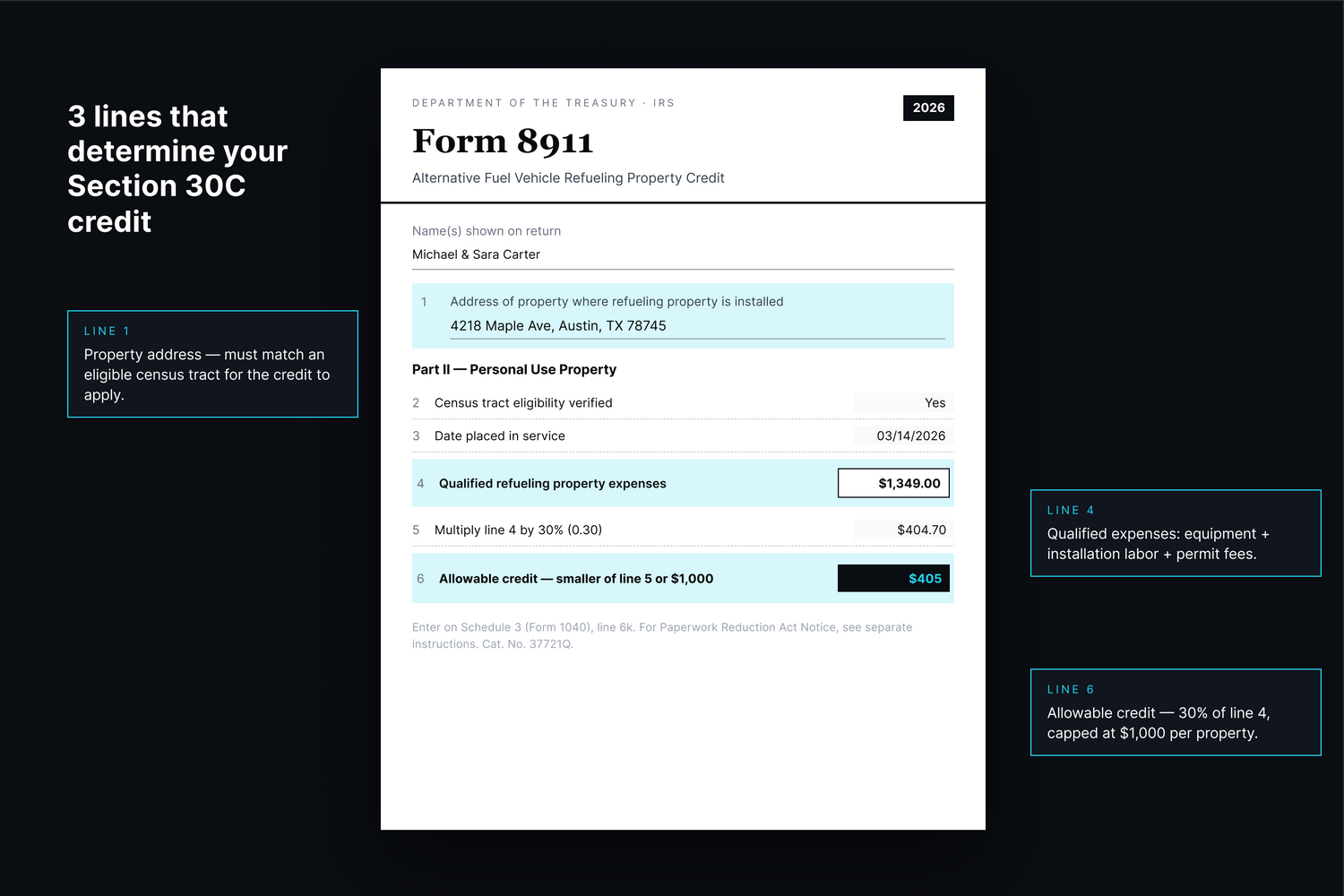
The federal EV charger tax credit (Section 30C) expired on June 30, 2026 — the One Big Beautiful Bill Act moved its end date up from 2032. If your charger was installed and operational by the deadline, you can still claim 30% back, up to $1,000, by filing IRS Form 8911 with your 2026 return. If you missed it, the money has moved to state and utility rebates ($200 to $1,000+) and off-peak electricity rates. See what is live for your address →
For years, Section 30C of the tax code returned 30% of a home EV charger installation. That chapter closed on June 30, 2026. This guide covers both sides of the deadline: exactly how to claim the credit if your charger went in on time, and what still pays if it did not.
What happened to Section 30C
The Inflation Reduction Act of 2022 had extended the Alternative Fuel Vehicle Refueling Property Credit through December 31, 2032. The One Big Beautiful Bill Act, signed in July 2025, terminated it early: the credit no longer applies to chargers placed in service after June 30, 2026. No extension is currently in law.
It capped a season of federal sunsets — the $7,500 new-EV purchase credit (Section 30D) and the $4,000 used-EV credit ended on September 30, 2025. What was not touched is everything below the federal level: state incentive programs, utility rebates, and time-of-use electricity rates are all still running.
| Incentive | Status in July 2026 |
|---|---|
| Federal charger credit (Section 30C) | Ended June 30, 2026 — still claimable for installs completed by the deadline |
| Federal EV purchase credits (30D / 25E) | Ended September 30, 2025 |
| State rebates and tax credits | ✅ Active — varies by state |
| Utility rebates | ✅ Active — commonly $200 to $1,000+ |
| Time-of-use (off-peak) rates | ✅ Active — permanent |
Installed by June 30, 2026? Here is how to claim your credit

How the Section 30C credit works for pre-deadline installs.
The termination applies to property placed in service after June 30, 2026 — meaning installed and operational, not merely purchased. If your charger was up and running by the deadline, the credit is still yours to claim:
- 30% of qualified expenses, capped at $1,000 for a residential install
- Claimed on IRS Form 8911 with your 2026 federal return (due April 15, 2027)
- Nonrefundable — it reduces tax you owe dollar-for-dollar, but does not pay out beyond that
- One credit per property per tax year
The census tract requirement still applies

Eligibility depends on the census tract of the installation address.
Under the 2024 Treasury rules, the install address must sit in a low-income or non-urban census tract — either condition qualifies, and roughly two-thirds of US tracts do, including many ordinary suburbs. Verify your address with the IRS Section 30C lookup tool before filing, and save a screenshot of the result with your records.
What counted as a qualified expense
- The charger itself (including sales tax)
- Licensed electrician labor, itemized on the invoice
- Wire, conduit, breakers and a NEMA 14-50 outlet installed for EV charging
- Permit and inspection fees
- An electrical panel upgrade (separate home infrastructure)
- The vehicle itself (that was Section 30D — ended September 2025)
- Extended warranties, service plans, or the mobile connector that came with the car
Filing Form 8911

Form 8911 goes with your Form 1040 for the year the charger became operational.
Gather the purchase invoice, the electrician invoice, permit receipts, and your census-tract verification, then file Form 8911 with your 1040. Major tax software handles it under energy credits; if you use a preparer, mention Section 30C explicitly. Keep all documentation for at least three years.
Missed the deadline? What still pays in July 2026

The remaining stack: state programs + utility rebates + off-peak rates.
The federal layer is gone, but for many households it was never the biggest one. Live programs in July 2026 include:
- ComEd (Illinois) — $1,000 toward a residential Level 2 installation, up to $2,500 for qualifying customers, for chargers installed through December 31, 2026. Enrollment in a time-of-use rate is required to claim it.
- LADWP (Los Angeles) — up to $1,000 on a qualified home charger, up to $1,500 for income-qualified customers.
- Consumers Energy (Michigan) — up to $500, rising to $1,000 for income-qualified households.
Programs like these are typically first-come, first-served and change during the year, so confirm the current offer for your exact address before buying. Our rebate finder pulls live state and utility programs by ZIP code.
The incentive that never expires: off-peak rates
A driver covering 1,000 miles a month uses roughly 300 kWh. Shifting that charging into an overnight window priced five to seven cents below the standard rate saves $15 to $20 a month — roughly $900 to $1,200 over a five-year ownership period, on par with or above the $1,000 ceiling the federal credit ever paid. A smart charger with a subscription-free scheduling app does this automatically.
How to stack incentives now
- Pre-deadline install? File Form 8911 with your 2026 return (30%, up to $1,000).
- Check your state program for your ZIP — amounts and funding change often.
- Claim your utility rebate right after installation — application windows of 30 to 90 days are common.
- Switch to a time-of-use plan and schedule charging off-peak.
- Keep receipts and the charger's certification details — nearly every program asks for a UL- or ETL-listed, Energy Star-certified unit.
Frequently asked questions
Is the federal EV charger tax credit still available in 2026?
Not for new installations. Section 30C expired for chargers placed in service after June 30, 2026, under the One Big Beautiful Bill Act. Installs completed by the deadline can still be claimed — 30% of equipment and installation, up to $1,000 — on IRS Form 8911 with a 2026 return.
I installed my charger in early 2026. Can I still claim the credit?
Yes. If the charger was installed and operational by June 30, 2026, and your address is in an eligible census tract, file Form 8911 for tax year 2026 (due April 15, 2027) and keep your equipment and installation receipts.
I bought a charger before June 30 but installed it later. Do I qualify?
No. The test is when the property was placed in service — installed and operational — not when it was purchased. A charger installed in July 2026 does not qualify, regardless of the purchase date.
I installed in 2024 or 2025 and never claimed. Is it too late?
No. File Form 1040-X (amended return) within three years of the original filing deadline for the year the charger became operational. For installations after March 2024, the census-tract eligibility requirement applies.
Will the federal credit come back?
No extension or replacement is in current law. Any revival would require new legislation, so treat the credit as ended and verify against current IRS guidance before making plans around it.
What EV charger incentives still exist?
State incentive programs, utility rebates (commonly $200 to $500, and up to $1,000–$2,500 in programs like ComEd's), managed-charging bill credits, and time-of-use electricity rates. All of these sit below the federal level and were unaffected by the expiration.
Do the remaining rebates require a specific charger?
Almost always a UL- or ETL-listed, Energy Star-certified Level 2 charger, and many utility programs require WiFi connectivity for scheduling. Check your program's qualified-equipment list before buying.
Did the $7,500 EV purchase credit also end?
Yes. The Section 30D new-EV credit and the Section 25E used-EV credit both ended on September 30, 2025 — nine months before the charger credit followed.
Does the expiration apply to business installations too?
Yes. The Section 30C termination covers property placed in service after June 30, 2026 for both residential and commercial installations.
Can renters claim anything?
The federal credit went to whoever owned and installed the qualifying property, which usually excluded renters. Among the remaining incentives, many utility rebate programs do allow renters to apply with the landlord's consent — check the individual program rules.
The bottom line
The federal charger credit is gone for new installations, but the incentive landscape is thinner, not empty. If you beat the June 30 deadline, claim your 30% on Form 8911 with your 2026 return. If you did not, stack what remains: check your state, claim your utility's rebate quickly, and let off-peak scheduling pay you back every night — it is worth more over a typical ownership period than the one-time credit ever was. Whatever you buy, make it a certified unit, because that is what every remaining program requires.

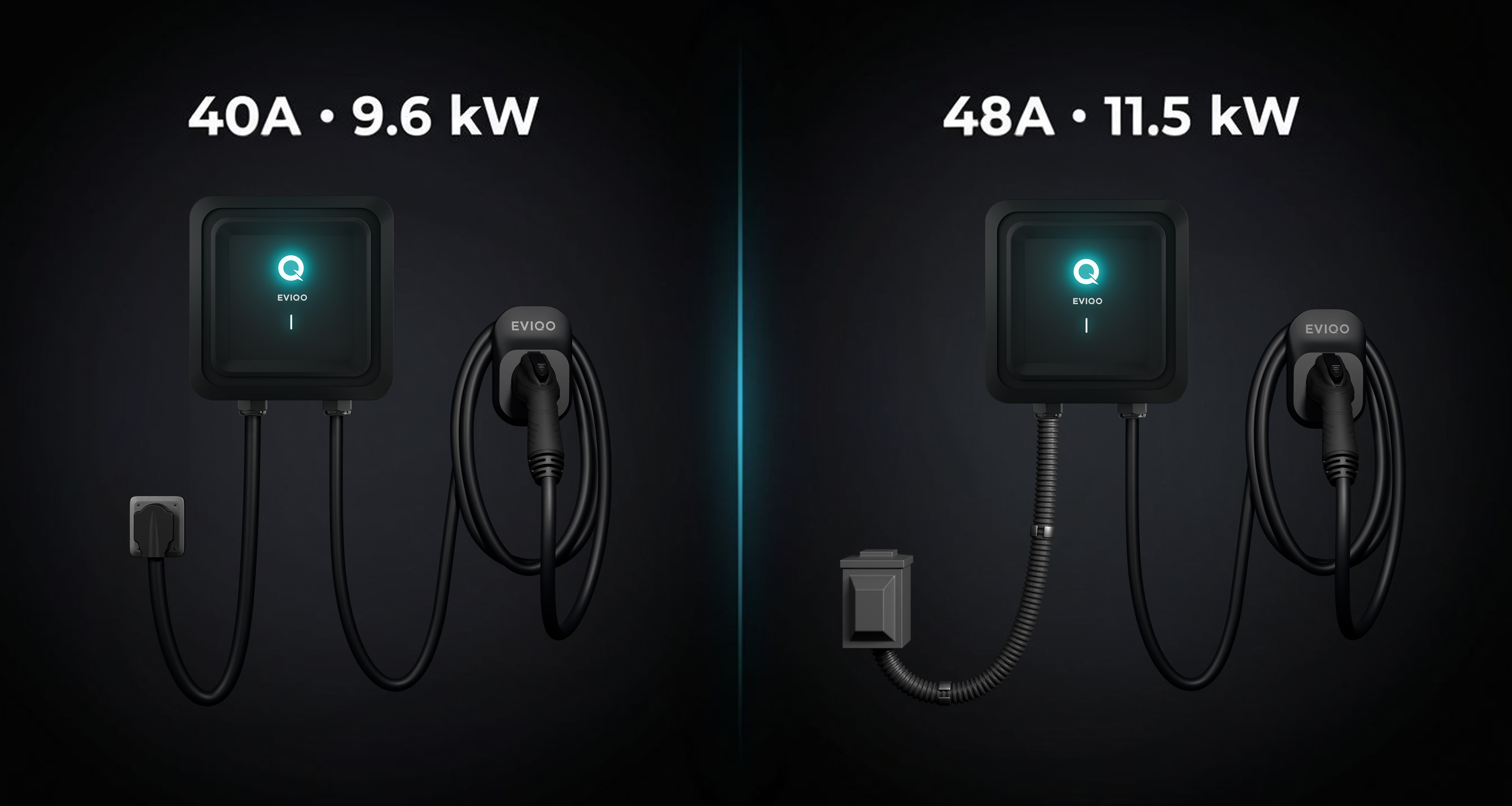
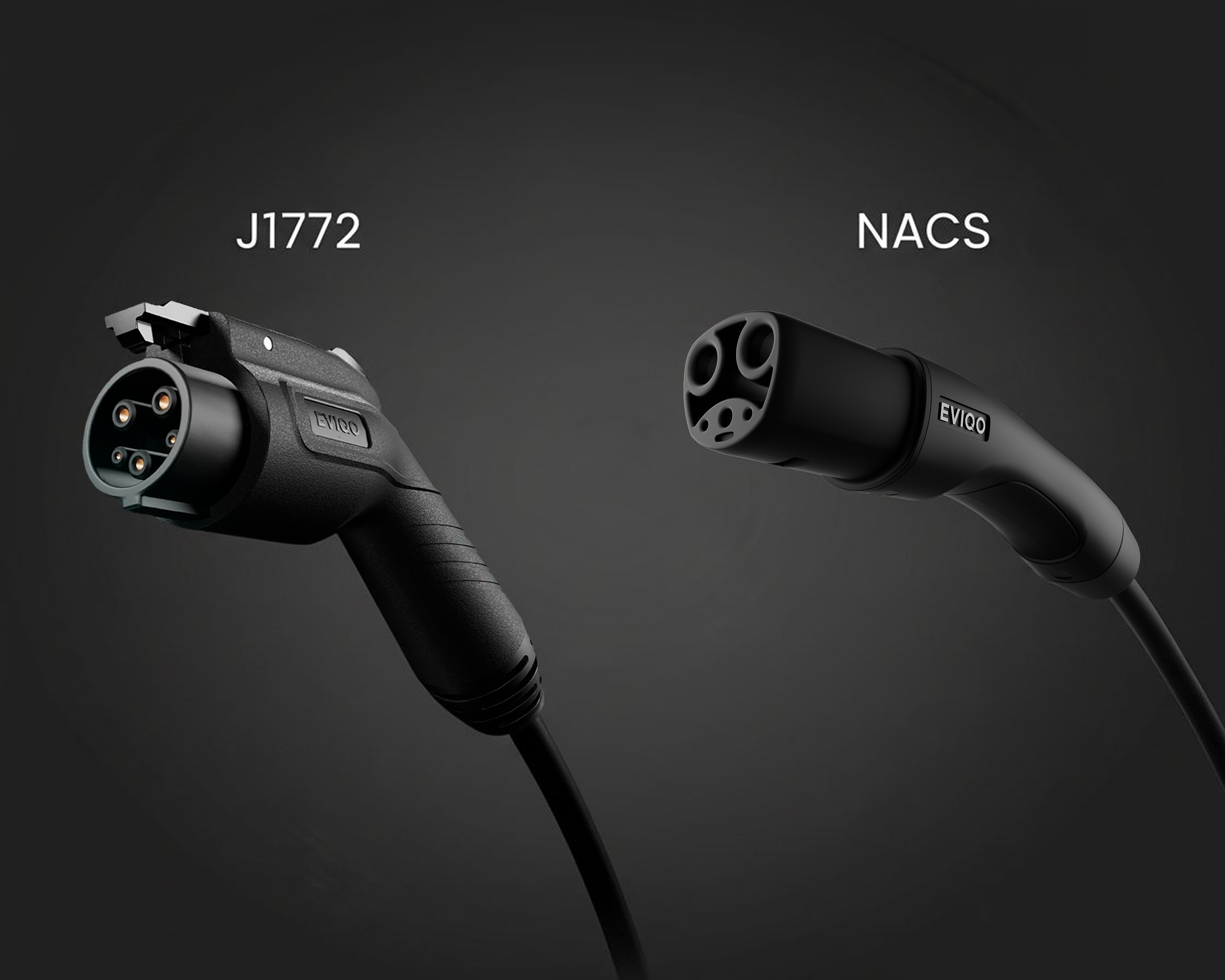
EVIQO Level 2 Charger — 40A Plug-In (J1772)
Plugs into a NEMA 14-50 outlet — 9.6 kW, up to ~37 mi/hr. UL/ETL and Energy Star certified, so it qualifies for the rebate programs above. 25 ft cable, IP66, subscription-free app. Rated 4.92★.
$396.99$570.00Shop 40A Plug-In →

EVIQO Level 2 Charger — 48A Hardwired (J1772)
Hardwired for the full 11.5 kW — up to ~44 mi/hr, adjustable to 50A. Best for long commutes and outdoor mounting. NEMA 4/IP66, 25 ft cable, 3-yr warranty. Rated 4.91★.
$480.99$509.00Shop 48A Hardwired →
For total installation costs in 2026, see our complete installation cost breakdown. For state and utility programs by ZIP, use the EV charger rebates database. For installation help with tax-ready invoices, Treehouse Pro provides EV-charger-certified electricians at flat-rate pricing. Questions about your setup? Contact us.
Disclaimer
This article provides general information about the Section 30C federal tax credit and other EV charging incentives as of July 2026. It is not tax advice for your specific situation. Tax laws and rebate programs change frequently — always consult a licensed tax professional and verify current IRS and program guidance before claiming.


Leave a comment
This site is protected by hCaptcha and the hCaptcha Privacy Policy and Terms of Service apply.