

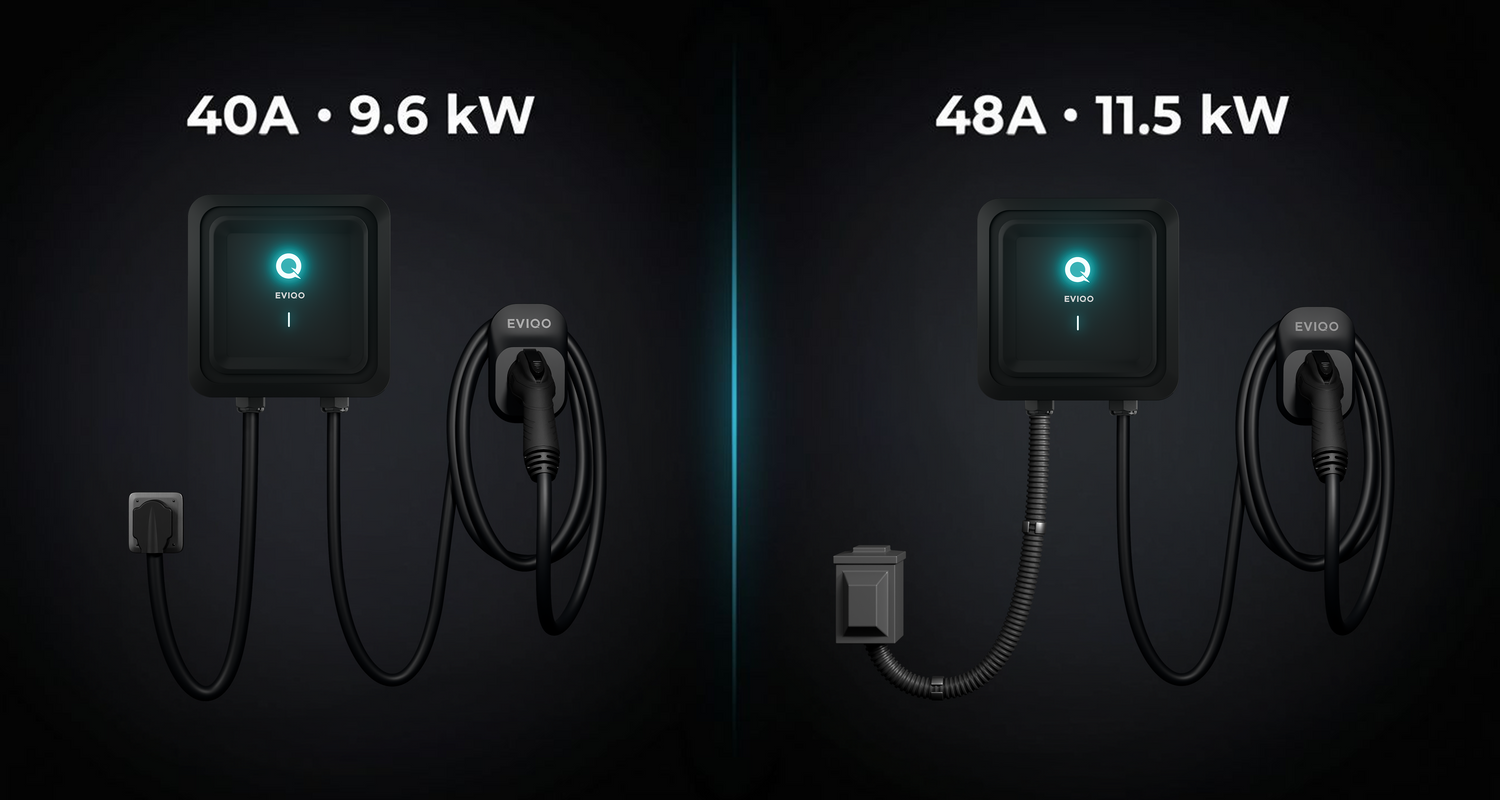
A 40A charger (9.6 kW) fully charges any EV overnight and covers normal daily driving with room to spare — the right pick for most homes. Choose 48A (11.5 kW, ~20–25% faster) if you drive a long-range EV, have a long commute, or want maximum future-proofing — but it needs a 60A circuit and a hardwired install, and your car’s onboard charger has to accept 48A to benefit.
When shopping for a Level 2 home EV charger, the amperage rating is the spec most buyers either skip past or completely misunderstand. “40 amps” vs “48 amps” sounds like a minor difference — and on the surface, the gap is just 20%. But the practical impact of that 20% extra power affects everything from your charging routine to your electrical panel costs to your charger’s resale value.
This guide explains what amperage actually controls, when you genuinely need 48A, when 40A is plenty, and how to make the right call for your specific EV and home in 2026.
The 80% rule: what amperage actually means
Before comparing 40A and 48A chargers, you need to understand the math the National Electrical Code uses.
The “continuous load” rule (NEC Article 625)
EV charging is classified as a continuous load — a load that runs at full power for 3+ hours straight. For continuous loads, NEC code requires the circuit’s breaker to handle 125% of the continuous load, which means the continuous load is 80% of the breaker rating.
In practical terms:
- A 50A breaker safely supports a 40A continuous EV charger (40 / 50 = 80%)
- A 60A breaker safely supports a 48A continuous EV charger (48 / 60 = 80%)
- A 40A breaker safely supports only a 32A continuous EV charger
This is why you’ll see seemingly mismatched numbers: a “48A charger” actually runs at 48A continuous, but it requires a 60A breaker. The breaker is sized larger as a safety margin.
The power math: amps × volts = watts
In North America, residential Level 2 chargers run on 240V AC. So:
| Charger Amperage | Continuous Power Output | Voltage | Total kW Output |
|---|---|---|---|
| 32A | 32A | 240V | 7.7 kW |
| 40A | 40A | 240V | 9.6 kW |
| 48A | 48A | 240V | 11.5 kW |
| 50A* | 50A | 240V | 12 kW (*via dip switch in some models) |
*Note: 50A continuous requires an 80A breaker, which is rare in residential settings. Most 48A chargers can be set to 50A via internal configuration, but this requires a 70A or 80A breaker — uncommon.
The bottom line: going from 40A to 48A adds 20% more charging power. That extra 1.9 kW translates into real time saved.
40A vs 48A real-world charging speed
Time matters more than amperage spec. Here’s the actual difference when charging real EVs.
Charging speed by EV battery size
| EV (battery) | 40A charging speed (9.6 kW) | 48A charging speed (11.5 kW) | Time to fully charge 20% → 80% |
|---|---|---|---|
| Tesla Model 3 SR+ (60 kWh) | ~30 mi/hr | ~37 mi/hr | 40A: 3.7 hrs / 48A: 3.1 hrs |
| Chevy Bolt EUV (65 kWh) | ~30 mi/hr | ~37 mi/hr | 40A: 4.0 hrs / 48A: 3.4 hrs |
| Tesla Model Y LR (75 kWh) | ~30 mi/hr | ~37 mi/hr | 40A: 4.7 hrs / 48A: 3.9 hrs |
| Ford Mach-E ER (88 kWh) | ~29 mi/hr | ~36 mi/hr | 40A: 5.5 hrs / 48A: 4.6 hrs |
| Hyundai Ioniq 5 (77 kWh) | ~30 mi/hr | ~37 mi/hr | 40A: 4.8 hrs / 48A: 4.0 hrs |
| Ford Lightning ER (131 kWh) | ~26 mi/hr | ~32 mi/hr | 40A: 8.2 hrs / 48A: 6.8 hrs |
| Tesla Cybertruck (123 kWh) | ~26 mi/hr | ~32 mi/hr | 40A: 7.7 hrs / 48A: 6.4 hrs |
| GMC Hummer EV (212 kWh, 350 mi) | ~26 mi/hr | ~32 mi/hr | 40A: 13.3 hrs / 48A: 11.1 hrs |
What this saves you in practical terms
For a typical Tesla Model Y owner charging from 30% to 80% overnight:
- 40A charger: 4 hours of charging
- 48A charger: 3 hours, 20 minutes of charging
- Time saved: 40 minutes per session
That doesn’t sound like much. But:
- Across 200 charging sessions per year: 133 hours of saved charging time (5.5 days)
- Allows charging to fit in shorter off-peak utility windows (typically 11 PM – 7 AM)
- Provides more buffer for unexpected back-to-back driving days
For long-range EV owners (Lightning, Cybertruck, Sierra Denali EV, Hummer EV), the savings are bigger because the larger battery means absolute time difference grows.
Electrical requirements for each amperage

Breaker sizing under the NEC 80% continuous-load rule.
This is where the decision gets practical.
40A continuous charger requirements
- Breaker: 50A double-pole
- Wire gauge: 6 AWG copper THHN (minimum) — runs over 100 feet may need 4 AWG
- Plug option (NEMA 14-50): Yes — 40A is the maximum for a NEMA 14-50 outlet setup
- Hardwire option: Yes — but more amperage available via hardwire makes 48A typically the better hardwired choice
- Service requirements: 100A panel works for most homes; 200A definitely works
- GFCI: Required for outdoor NEMA 14-50 outlets
48A continuous charger requirements
- Breaker: 60A double-pole
- Wire gauge: 4 AWG copper THHN (minimum) — long runs may need 3 or 2 AWG
- Plug option (NEMA 14-50): NOT possible — NEMA 14-50 outlets max out at 40A continuous
- Hardwire option: Yes — this is the typical 48A setup
- Service requirements: 200A panel strongly recommended; 150A possible with careful load calculation
- GFCI: Required (internal to most modern chargers, no separate GFCI needed)
Side-by-side comparison
| Requirement | 40A | 48A |
|---|---|---|
| Continuous output | 9.6 kW | 11.5 kW |
| Breaker size | 50A | 60A |
| Wire gauge minimum | 6 AWG | 4 AWG |
| Wire cost (50 ft) | $175–$250 | $275–$375 |
| Install type required | Plug-in or hardwired | Hardwired only |
| Service requirement | 100A+ | 200A preferred |
| Best outdoor scenario | With outdoor NEMA 14-50 box | Yes (NEMA 4 / IP66 charger) |
What this means for your install cost
A 48A hardwired install typically costs $200–$500 more than a 40A NEMA 14-50 install due to:
- Larger wire gauge ($100–$130 extra in materials)
- More labor (hardwiring is more complex than outlet install)
- Larger breaker ($30–$60 extra)
- Better wire-pulling techniques required
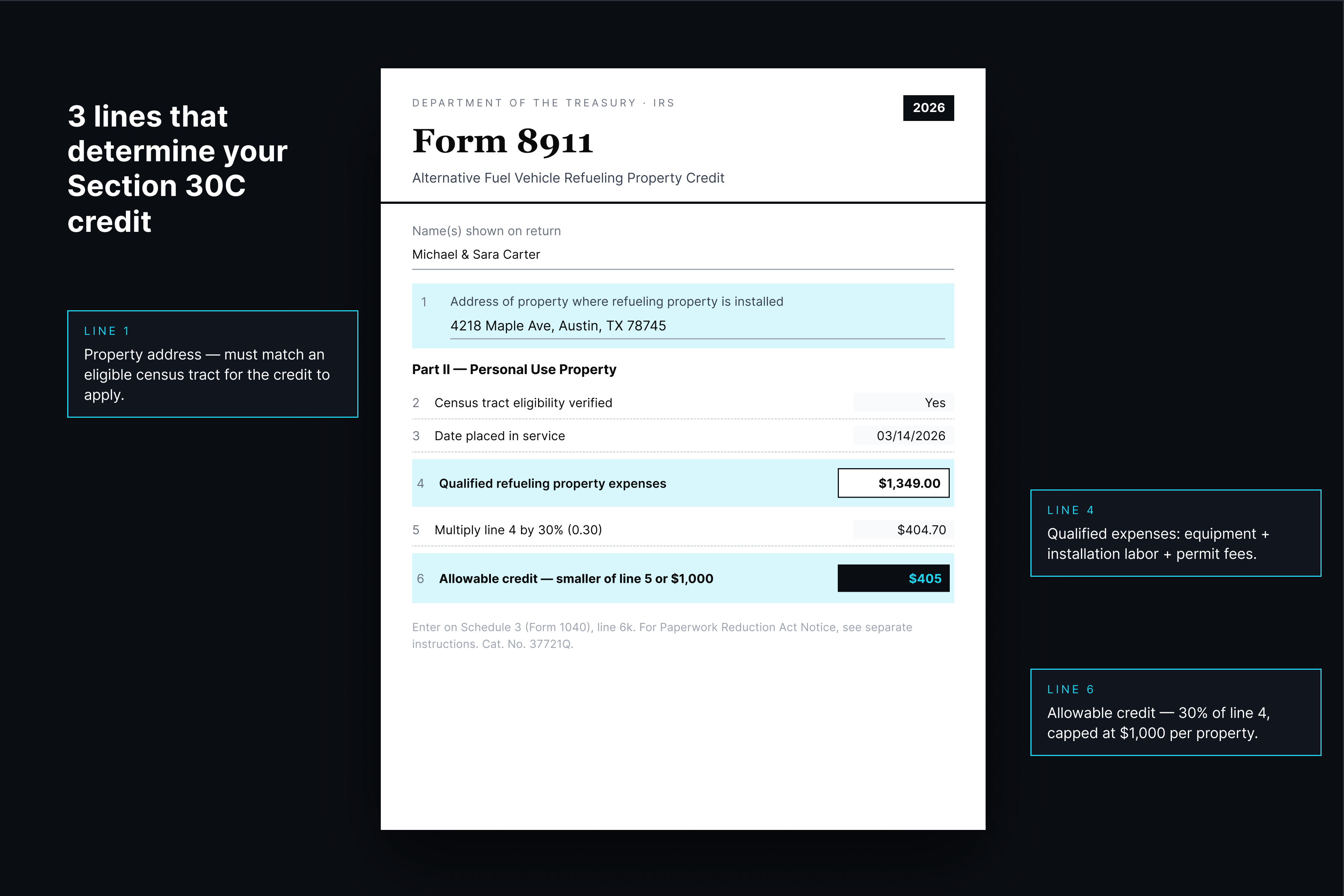
But the federal tax credit doesn’t care about amperage — both qualify for 30% back, capped at $1,000.
See full breakdown of installation costs →
Which EVs benefit from 48A (and which don’t)

Onboard AC charge rates by EV — who can use 48A.
The honest answer: it depends on your EV’s onboard AC charger rating.
Why this matters
Even if your home charger delivers 48A (11.5 kW), your EV’s onboard AC charging system has its own maximum rate. The EV chooses the lower of the two. So:
- 48A charger + EV with 11.5 kW onboard charging = 11.5 kW (full speed)
- 48A charger + EV with 7.7 kW onboard charging = 7.7 kW (capped by car)
- 40A charger + any modern EV (most can do 11.5 kW) = 9.6 kW (capped by charger)
EVs that fully utilize 48A (worth getting a 48A charger)
| Manufacturer | Models | Onboard AC charge rate |
|---|---|---|
| Tesla | Model 3, Y, S, X, Cybertruck | 11.5 kW (some 9.6 kW) |
| Ford | Mach-E, F-150 Lightning | 11.5 kW |
| GM | Lyriq, Silverado EV, Sierra EV | 11.5 kW |
| Rivian | R1T, R1S | 11.5 kW |
| Hyundai | Ioniq 5, Ioniq 6, Ioniq 9 | 10.9 kW |
| Kia | EV6, EV9 | 10.9 kW |
| Polestar | 2, 3 | 11.5 kW |
| Lucid | Air | 19.2 kW (!) — needs even more |
| BMW | iX, i4, i5 | 11.5 kW |
| Volvo | XC40 Recharge, EX90 | 11.5 kW |
| Mercedes | EQS, EQE | 11.5 kW |
EVs limited to 40A or less (40A charger is sufficient)
| Manufacturer | Models | Onboard AC charge rate |
|---|---|---|
| Chevy | Bolt EV / EUV | 7.7 kW (10A 240V) |
| Nissan | Leaf | 6.6 kW |
| Toyota | bZ4X | 7.7 kW |
| Subaru | Solterra | 7.7 kW |
| Mazda | MX-30 | 6.6 kW |
| VW | ID.4 (older model years) | 11.5 kW newer / 7.7 kW older |
| Plug-in hybrids (most) | Various | 3.3–7.7 kW |
Key insight: If you own a Bolt or Leaf and only need to charge that vehicle, you’d see no benefit from 48A — the car can’t accept more than ~7.7 kW. A 40A charger (9.6 kW max) already exceeds the car’s onboard limit by 25%.
But if you might upgrade to a Tesla, Lightning, or Mach-E next, 48A is worth it.
Cost difference between 40A and 48A setups
Total cost difference for typical 2026 installation:
| Cost component | 40A NEMA 14-50 | 48A Hardwired | Difference |
|---|---|---|---|
| Charger | $379 | $429 | +$50 |
| Breaker (50A vs 60A) | $40 | $90 | +$50 |
| Wire (50 ft, 6 vs 4 AWG) | $215 | $335 | +$120 |
| Junction box / outlet | $50 | $40 | -$10 |
| Labor (3 hrs vs 4 hrs) | $300 | $400 | +$100 |
| Permit + inspection | $75 | $90 | +$15 |
| Total | $1,059 | $1,384 | +$325 |
After Section 30C federal tax credit (30% on first $1,000):
| Calculation | 40A | 48A |
|---|---|---|
| Pre-credit cost | $1,059 | $1,384 |
| Credit | -$318 | -$415 |
| Net cost | $741 | $969 |
The $228 effective difference for 48A is small relative to the lifetime savings: 5+ years of faster charging on an EV that benefits from it.
The future-proofing argument
This is the strongest case for choosing 48A even if your current EV doesn’t fully use it.
Why future-proofing matters
If you’re buying an EV charger in 2026, you’ll likely use it through 2032+. Three things will change in that time:
- 1. EV battery sizes will grow significantly.
| Year | Average BEV battery | Top-tier BEV battery |
|---|---|---|
| 2020 | 60 kWh | 100 kWh (Tesla Model S Plaid) |
| 2025 | 80 kWh | 200 kWh (GMC Hummer EV) |
| 2030 | 95 kWh | 240+ kWh (luxury and trucks) |
A 40A charger that fully charges your 2025 Model Y overnight will take longer to fully charge a 2030 Model Y with a bigger battery.
- 2. Off-peak electricity windows are shrinking.
Utility “off-peak” rates used to be available all night (11 PM – 7 AM, 8 hours). Increasingly, utilities are tightening this to 6-hour windows or even time-of-use rates with shifting peak hours. A faster charger fits more easily into these tighter windows.
- 3. You might upgrade to a longer-range EV.
If your current EV is a 75 kWh Model Y but your next car is a 130 kWh Ford Lightning, the 48A charger that took 5 hours for the Model Y will take 6.5 hours for the Lightning. With a 40A charger, that becomes 8 hours.
When future-proofing isn’t worth it
- You’re definitely sticking with a small-battery EV (Bolt, Leaf, plug-in hybrid)
- You move every 1–3 years (you can’t take a hardwired charger with you)
- Your home’s electrical service is 100A and a panel upgrade doesn’t fit the budget
- You charge mostly at public stations and only top off at home
For everyone else: 48A is the safer long-term choice.
When you’d want a 50A or higher charger

50A vs 60A breaker sizing for higher-amperage charging.
The premium tier of home charging.
50A charging (uncommon, requires specialized setup)
Some EV chargers can be configured for 50A continuous (12 kW). Requirements:
- 70A or 80A breaker (depending on charger spec)
- 3 AWG or 2 AWG copper wire (heavy gauge, expensive)
- 200A panel preferred (some 150A might support with load management)
- Specific charger model (EVIQO chargers support 50A via internal config; not all brands do)
50A delivers about 4% faster charging than 48A. For most users, the cost premium isn’t worth it. For Lucid Air owners (which accepts up to 19.2 kW AC, equivalent to 80A!), the answer is more nuanced — see below.
80A charging (rare, mostly fleet/commercial)
Some EVs (Lucid Air, Tesla Model S Plaid in dual-charger config) accept up to 19.2 kW from AC charging. This requires:
- 100A breaker
- 1/0 AWG wire (very heavy gauge)
- Dedicated commercial-grade equipment
- Specialized installation
For most home users, 80A is overkill. It’s relevant if:
- You own a Lucid Air and want to fully charge in <6 hours (a 19.2 kW charger does it in 5)
- You operate a fleet of EVs from your home property
- You want maximum future-proofing for unknown EV upgrades
The vast majority of home EV charger buyers in 2026 should focus on 40A vs 48A.
Decision matrix by household situation
| Your situation | Recommended amperage |
|---|---|
| Own a 2026+ Tesla, Ford, GM, Hyundai, or Rivian | 48A — your car accepts it |
| Own a Chevy Bolt or Nissan Leaf | 40A — your car is the limit |
| Own a plug-in hybrid only | 32–40A — anything more is wasted |
| Plan to upgrade EV in next 5 years | 48A — future-proof |
| Stay in same EV for 8+ years and it’s a small battery | 40A — no need for more |
| Have an older 100A panel | 40A — typically fits without upgrade |
| Have a modern 200A panel | 48A — capacity supports it |
| Need outdoor installation | 48A with NEMA 4 / IP66 rating |
| Need indoor installation only | Either works |
| Budget-constrained ($800 total install max) | 40A NEMA 14-50 |
| Premium quality focus (longevity, performance) | 48A hardwired |
| Renting and might move in 2 years | 40A NEMA 14-50 (portable) |
| Homeowner planning to stay 5+ years | 48A hardwired |
| Two EVs charging from same circuit | 48A with load management |
| Have rooftop solar | 48A or higher to use peak solar production |
Common myths about EV charger amperage
Myth 1: “More amps = faster charging always”
Half-true. More amps gives more charging power, but only if your EV’s onboard charger can use it. A 48A charger feeding a Bolt is bottlenecked at the car (7.7 kW), so 40A and 48A deliver identical real-world speed for that vehicle.
Myth 2: “A 48A charger draws 48A constantly when plugged in”
False. The charger only draws current when actively charging. When the car is at 100%, the charger sips milliwatts. When idle, similar story.
Myth 3: “I’ll save energy by using a lower-amperage charger”
False. Total energy delivered is the same. A 40A charger delivers 9.6 kW for 5 hours = 48 kWh. A 48A charger delivers 11.5 kW for 4.2 hours = 48 kWh. Same total. You’re just choosing whether to deliver it slower or faster.
Myth 4: “Higher-amperage chargers wear out my battery faster”
False for AC Level 2 charging. The 5–10x slower current of Level 2 charging is well-tolerated by all modern EV batteries. The thermal stress that wears batteries is from DC fast charging (150–350 kW), not Level 2. Whether you charge at 40A or 48A, the impact on battery longevity is negligible.
Myth 5: “If my breaker is rated 50A, I can use a 48A charger”
False — this is a code violation. NEC requires continuous loads to be 80% of breaker rating. A 50A breaker supports 40A continuous (40 / 50 = 80%). For 48A continuous, you need a 60A breaker (48 / 60 = 80%).
Myth 6: “All chargers above 32A require hardwiring”
False. NEMA 14-50 outlets support up to 40A continuous (50A nominal × 80%). So 40A chargers can be plug-in via NEMA 14-50. Only 48A+ requires hardwiring (because no standard NEMA outlet supports that current).
Frequently asked questions
What’s the practical difference between 40A and 48A?
About 20% more charging power and 20% less time to fully charge. For a typical Tesla Model Y, that’s roughly 50 minutes saved per full charge. Over 200 charges/year, you save about 130 hours.
Can I increase my 40A charger to 48A later?
No — at least not without buying a new charger. Amperage rating is set at the factory based on the internal components (capacitors, contactors, switching elements). You can sometimes lower a 48A charger to 40A via dip switches, but going the other direction isn’t supported.
Why does my Tesla say it’s only charging at 32A?
Either your charger is limited to 32A, your home circuit is limited (50A breaker), or your Tesla is automatically reducing charging to extend battery longevity (set in vehicle settings). Check all three.
Does the 48A charger draw 48A all the time?
No. The charger draws power only when actively charging your EV. Idle, it draws milliwatts. Peak draw occurs only when the EV is requesting full power.
Is 48A safe for residential installation?
Yes, with proper electrical infrastructure. 48A continuous charging is well within safe operation for properly sized 60A breakers, 4 AWG copper wire, and modern panels. Building codes specifically anticipate this load.
What about 50A charging — should I consider it?
Only if you have very specific needs (Lucid Air owner, want maximum charging speed, willing to pay premium for specialized wiring). For 95% of home users, 48A is the sweet spot.
Can I run a 48A charger on 100A service?
Maybe — depends on your other electrical loads. A 48A continuous EV charger draws 11.5 kW peak. If you also have central AC (10–14 kW peak), electric water heater (4 kW), and electric range (10 kW), you’ll exceed 100A service capacity during simultaneous operation. Get a load calculation before committing.
Does 48A wear out my EV battery faster than 40A?
No detectable difference. Level 2 AC charging at either rate is gentle on EV batteries. The 20% extra current at 48A creates minimal additional heat versus 40A. Battery degradation concerns are valid for DC fast charging (150+ kW), not for either Level 2 amperage.
Are 48A chargers more expensive to own long-term?
Slightly. Higher capital cost ($50–$100 more for charger, $200–$300 more for installation). Same electricity rate (you’re paying per kWh, not per amp). Same warranty for most brands. Slightly higher resale value of a 48A charger vs 40A. Long-term: roughly comparable cost.
What’s the future of charger amperage?
Industry trend is moving toward higher continuous AC charging rates as battery sizes grow. 48A is becoming the “new standard” for residential. 80A high-power AC is becoming more common in luxury and commercial settings. The 40A rating won’t disappear (still cheap and adequate for most), but new builds increasingly default to 48A hardwired.
Can I use a 48A charger with a 50A breaker?
No — this is a code violation. You need a 60A breaker for 48A continuous (per the 80% rule). A 50A breaker only supports 40A continuous.
How do I know what amperage my EV can accept?
Check your owner’s manual for “onboard AC charger” or “maximum AC charging rate.” Tesla, Ford, GM, Hyundai, Rivian — all publish this. If not listed, check the car’s charging port specification. Modern EVs typically support 10.9 kW (Hyundai/Kia), 11.5 kW (most others), or 19.2 kW (Lucid).
Choose the right amperage for your home
The decision usually simplifies to:

EVIQO Level 2 Charger — 40A Plug-In (J1772)
Plugs into a NEMA 14-50 outlet — 9.6 kW, up to ~37 mi/hr. The simplest fast home charging for any non-Tesla EV. 25 ft cable, IP66, WiFi app. Rated 4.92★.
$470.99$570.00Shop 40A Plug-In →

EVIQO Level 2 Charger — 48A Hardwired (J1772)
Hardwired for the full 11.5 kW — up to ~44 mi/hr. Best for long commutes and outdoor mounting. NEMA 4/IP66, 25 ft cable, 3-yr warranty. Rated 4.91★.
$430.99$509.00Shop 48A Hardwired →
- Get 40A NEMA 14-50 if: you have an older 100A panel, you might move, you own a small-battery EV, or you want lowest install cost.
- Get 48A hardwired if: you have modern 200A service, you’ll stay 5+ years, you own (or might own) a long-range EV, or you want fastest realistic home charging.
EVIQO offers both options across all four collection hubs:
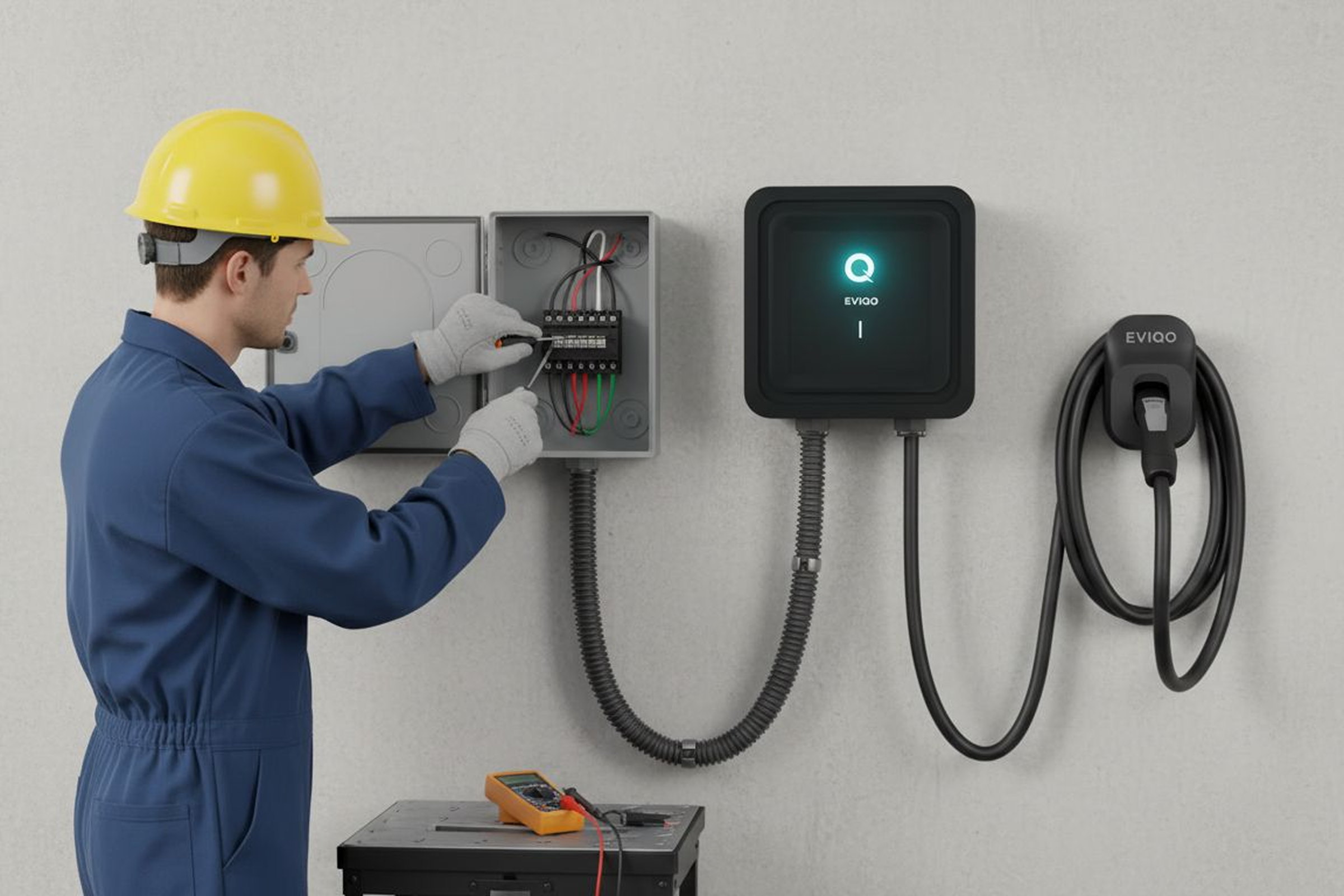
For hardwired 48A installation, we partner with Treehouse Pro — certified electricians with EV-charger-specific training and flat-rate pricing.
Want to monitor charging speed, schedule off-peak sessions, and track energy use? Every EVIQO charger pairs with the EVIQO smart app. For more detail on smart features and product specs, check the EVIQO Knowledge Base or browse verified expert reviews.
For a personalized recommendation based on your EV, electrical service, and home situation, contact our team — we respond within 2 business hours.


Leave a comment
This site is protected by hCaptcha and the hCaptcha Privacy Policy and Terms of Service apply.