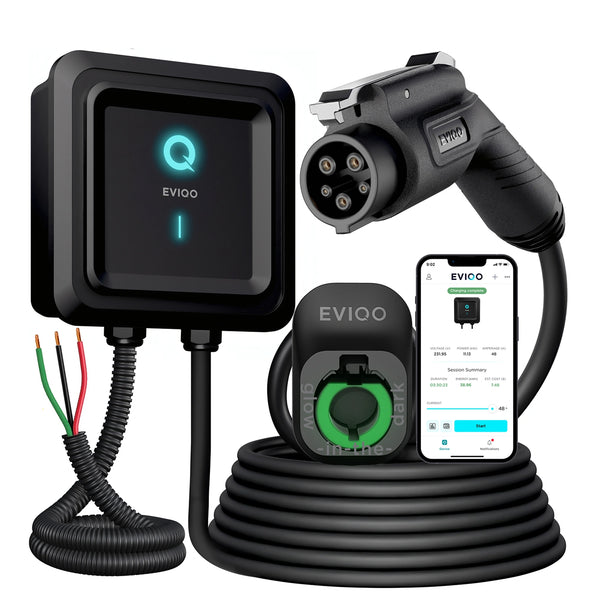
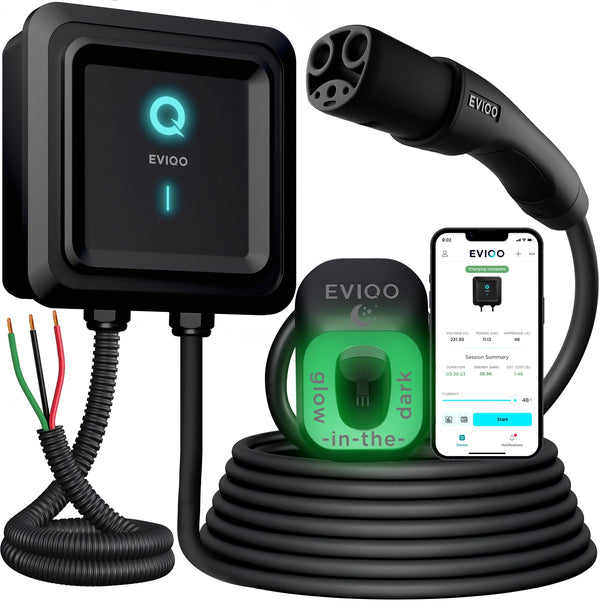
Direct-wired for maximum power — 20% faster than plug-in, cleanest install, no outlet to fail

Hardwired Level 2 EV Chargers — 48A / 11.5 kW

Hardwired Level 2 chargers connect directly to your home's electrical panel via a dedicated 60A circuit — giving you the full 48A / 11.5 kW EVIQO chargers can deliver. That's about 20% faster than the plug-in version, and the install looks cleaner with no visible outlet. Available in J1772 (for most pre-2025 EVs) and NACS (for Tesla and 2025+ EVs). Both UL/ETL/FCC/Energy Star certified.

ETL ListedUL CompliantFCCEnergy Star

Filters

Sort by:

2 products

SALE
EVIQO Level 2 EV Charger, 48A (50A Max), 240V, Hardwired, J1772 for Non-Tesla EVs
$509.99
$430.99
Why EVIQO

Built for everyday charging

  • Full 48A / 11.5 kW ~37–44 miles of range per hour for most EVs
  • 20% faster than 40A plug-in Saves ~1 hour overnight on a typical empty-to-full charge
  • No outlet, no plug to wear out Direct copper-to-charger connection lasts the life of the unit
  • Cleaner look, less wall clutter Single conduit entry — no visible NEMA 14-50 receptacle
  • No GFCI breaker required Integrated ground-fault protection built in
  • UL / ETL / FCC / Energy Star Federal & state rebate eligible
Side-by-side

Quick comparison

Model Connector Amperage Power Cable Best For
Gen 2 J1772 Hardwired J1772 48A 11.5 kW 25 ft Homeowners, max speed
Gen 2 NACS Hardwired
Fastest Tesla Home Charge
NACS (Tesla) 48A 11.5 kW 25 ft Tesla / 2025+ EVs

Prices in USD. Free shipping in the contiguous U.S. All units ETL Listed, FCC certified, Energy Star qualified.

Buying guide

Hardwired EV Charger Buying Guide

Why hardwire instead of plug-in?

Three reasons: speed (48A vs 40A — about 20% faster charging, saves an hour overnight), reliability (no NEMA 14-50 plug or receptacle to wear, loosen, or fail under heat from continuous high current), and aesthetics (a single conduit into the wall, no visible outlet). The trade-off is permanence — you can't unplug it and take it with you if you move. If you own your home and have access to a 60A circuit slot in your panel, hardwired is the better technical choice.

What electrical work is needed?

A 60A dedicated double-pole breaker, 6 AWG copper wire (L1 + L2 hot lines), and a 10 AWG ground (PE) wire — all in conduit, terminating in a junction box near the charger location. No neutral wire is needed; EVIQO chargers use L1/L2/PE only. Typical install cost: $400–$1,200 depending on panel proximity, wall run, and local rates. Always use a licensed electrician — this is required for code, permits, and rebate eligibility.

Do I need a GFCI breaker?

No. EVIQO hardwired chargers have integrated ground-fault protection (RCD) built into the unit — this satisfies NEC requirements for EV charging without an external GFCI breaker. (For NEMA 14-50 plug-in installs, some jurisdictions still require a GFCI breaker on the outlet — but for hardwired, you can use a standard 60A double-pole breaker.)

J1772 or NACS hardwired?

J1772 hardwired: Fits any non-Tesla EV sold in the U.S. through 2024 — Ford, GM, Hyundai, Kia, Nissan, Volkswagen, BMW, etc. (and Teslas via adapter). NACS hardwired: Direct fit for every Tesla and the 2025+ EVs from Ford, GM, Hyundai, Kia, Rivian, Honda, and others moving to NACS. If you have or plan to buy a Tesla — NACS. Otherwise — J1772 (and pick up a $25 adapter if you ever switch to a NACS EV later).

Will I really notice 48A vs 40A in real life?

On a small EV (Bolt, Leaf, Mini Cooper SE) — barely. Both fully charge overnight. On a midsize EV (Model Y, Mach-E, Ioniq 5) — about 1 hour saved on a full charge. On a truck or large SUV (Lightning, R1T, Hummer EV, Silverado EV) — 1–2 hours saved, which can matter if you're driving home late and out early. Bottom line: if you can install a 60A circuit, the upgrade pays for itself in convenience over the life of the charger.

Can I convert my plug-in EVIQO to hardwired?

Yes. The plug-in version (Gen 1 J1772) can be hardwired by a licensed electrician — remove the NEMA 14-50 cord, connect L1/L2/PE directly, switch the internal dial to position 3 (48A), and upgrade your breaker to 60A. Gen 2 chargers are factory-configured for either plug-in OR hardwired and aren't field-convertible — choose the right version at purchase.


Explore more

Other ways to charge

FAQ

Hardwired EV Charger — FAQ

What's the difference between hardwired and plug-in?

Hardwired chargers are permanently wired to your electrical panel through a junction box — up to 48A / 11.5 kW. Plug-in chargers use a NEMA 14-50 outlet — up to 40A / 9.6 kW. Hardwired is faster, cleaner-looking, and more durable; plug-in is portable and easier to relocate. Both are safe and code-compliant when installed by a licensed electrician.

How much faster is 48A vs 40A?

About 20% faster. A 40A charger delivers 9.6 kW; a 48A charger delivers 11.5 kW. On a typical EV with a 60–80 kWh battery, that's roughly 1 hour saved on a full charge.

Do I need a 60A breaker?

Yes, for the full 48A. The 80% rule in U.S. electrical code means a 60A breaker supports 48A of continuous load. If your panel only has space for a 50A circuit, you can still install an EVIQO hardwired charger and use the internal dial switch + app slider to limit it to 40A. (Position 2 on the dial = 50A breaker / 40A output.)

Is GFCI required?

Not for hardwired EVIQO chargers — they have integrated ground-fault protection built in. A standard 60A double-pole breaker is sufficient. For NEMA 14-50 plug-in installs, some local codes still require a GFCI breaker on the outlet.

What wire size do I need?

6 AWG THWN-2 copper for L1 and L2 (both hot conductors), 10 AWG for the protective earth/ground (PE). No neutral required. Use UL-listed M4 #8 ring terminals for the connections inside the charger. Torque to 12.39 in·lbs (1.4 N·m). Your electrician will know all this — but it's good to verify.

Can I install it myself?

Hardwired installations require a licensed electrician — this is for safety, code compliance, and rebate eligibility. Most U.S. utility rebate programs require a permit and licensed install. Plan on $400–$1,200 for the work, depending on panel distance and local rates.

Can the cable be lengthened?

The 25 ft charging cable is fixed — it ships welded to the charger and cannot be extended. Choose the holster mounting location so the cable reaches the EV's charge port with a few feet of slack. The 40-inch input cable (on the wall side) connects to the junction box.

Outdoor install?

Yes — IP66 / NEMA 4 rated, tested for -22°F to 122°F. Mount the charger on a stable surface (exterior wall, garage wall, post) with the holster nearby. Use weatherproof conduit and the included gaskets at the input cable entry. Always check local code for outdoor EVSE clearances.

What's the warranty on hardwired chargers?

Same as the plug-in line: 3 years standard, no registration required (activates at purchase). Extendable to 4 years as a paid add-on at checkout. Support: support@eviqo.io with your order number.

Can I move it if I sell my house?

Technically yes — a licensed electrician can disconnect, cap the wiring, and patch the wall. Most buyers value an installed EV charger and will keep it as a selling point. If you're a frequent mover, the plug-in version is easier — you can unplug and take it with you.