

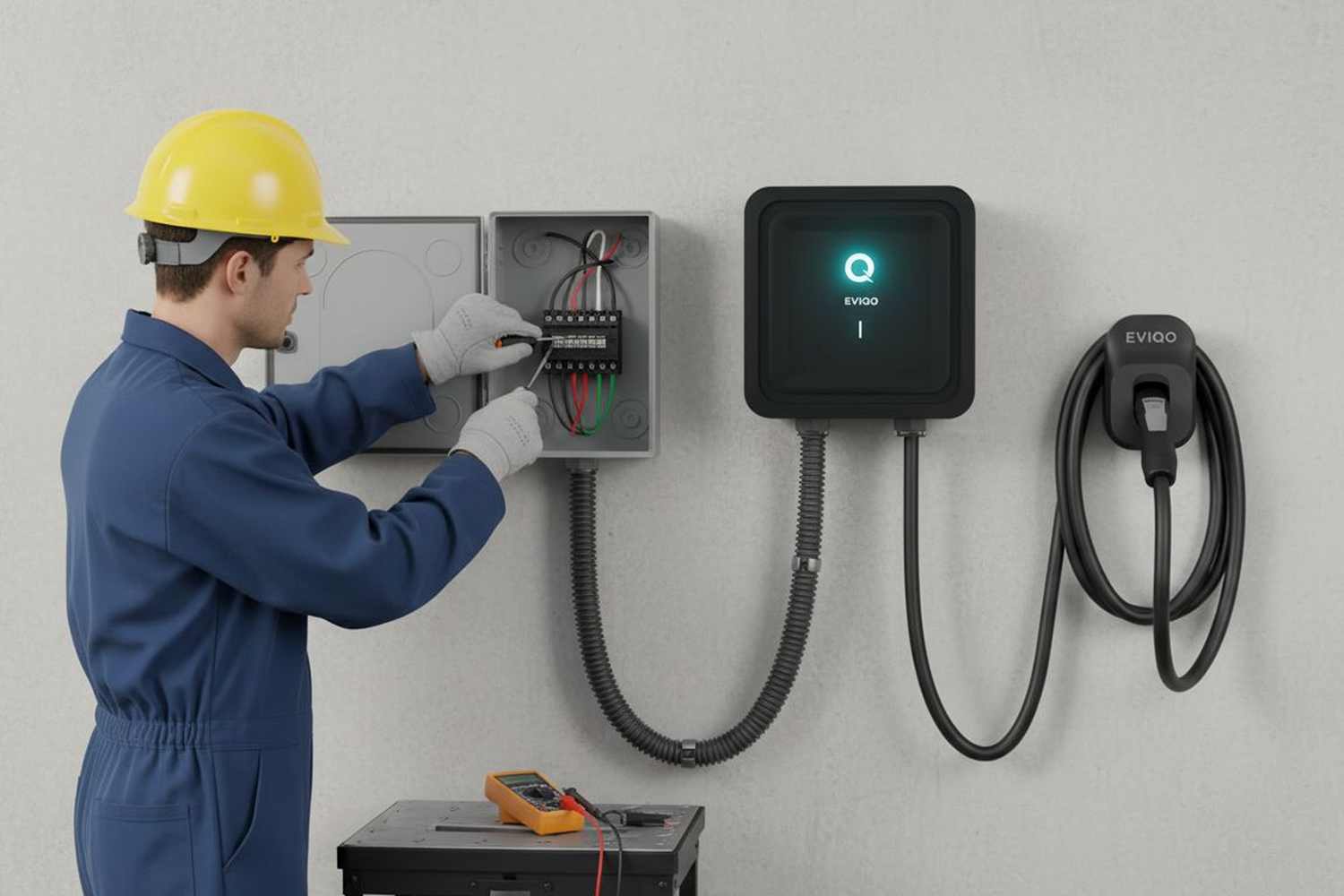
In 2026 a typical Level 2 home EV charger installation runs $1,000–$2,500 all-in (equipment + labor + permit), with most homeowners around $1,200–$1,800. A simple plug-in into an existing 240V outlet can be under $700; a hardwired job that needs a panel upgrade can exceed $4,000. The federal Section 30C tax credit returns 30% (up to $1,000) if your address qualifies.
Installing a Level 2 EV charger at home is one of those purchases where the headline price barely tells the story. The charger itself is $300–$600. The installation might be $400 — or it might be $4,500. The federal tax credit takes 30% off. Some states add another 20% on top. Your panel might be ready, or you might need to upgrade.
This guide breaks down every realistic cost component you’ll face installing a home EV charger in 2026 — with regional ranges, hidden fees most installers don’t mention upfront, and how to actually use the federal tax credit to reduce your out-of-pocket cost.
The realistic total cost in 2026

Where your installation budget actually goes.
Here’s the headline range based on thousands of installs across the US:
| Setup complexity | Total cost (before credits) | Total after federal tax credit |
|---|---|---|
| Simple (modern panel, charger near panel, NEMA 14-50) | $700–$1,200 | $490–$840 |
| Typical (modern panel, 30–50 ft wire run, hardwired) | $1,100–$1,900 | $770–$1,330 |
| Complex (older panel, sub-panel needed, long wire run) | $2,200–$4,500 | $1,540–$3,150 |
| Panel upgrade required (60A or 100A service) | $4,500–$8,500 | $3,150–$5,950 |
For most American households (modern 200A panel, garage charging, 30–40 foot wire run), expect $900–$1,800 total after the federal tax credit. The numbers below show what makes up that range.
Equipment cost: what you’re actually paying for
The EV charger itself accounts for $300–$650 of total project cost in 2026. Here’s what determines price.
Charger price tiers
| Tier | Price range | What you get |
|---|---|---|
| Budget ($199–$329) | Basic | 40A max, no app, simple LED indicator, often imported with limited US support |
| Mid-tier ($329–$499) | Most popular | 40–48A, WiFi app, scheduling, basic energy monitoring, US support, 2–3 year warranty |
| Premium ($499–$799) | Best value | 48A with outdoor rating (NEMA 4 / IP66), advanced energy management, OCPP compatibility, 3+ year warranty |
| Specialty ($799–$1,400) | Niche | Bidirectional (V2H), solar-integrated, multi-charger load balancing, fleet-grade |
What actually matters in the spec sheet
Beyond the price, these are the specs that affect long-term satisfaction:
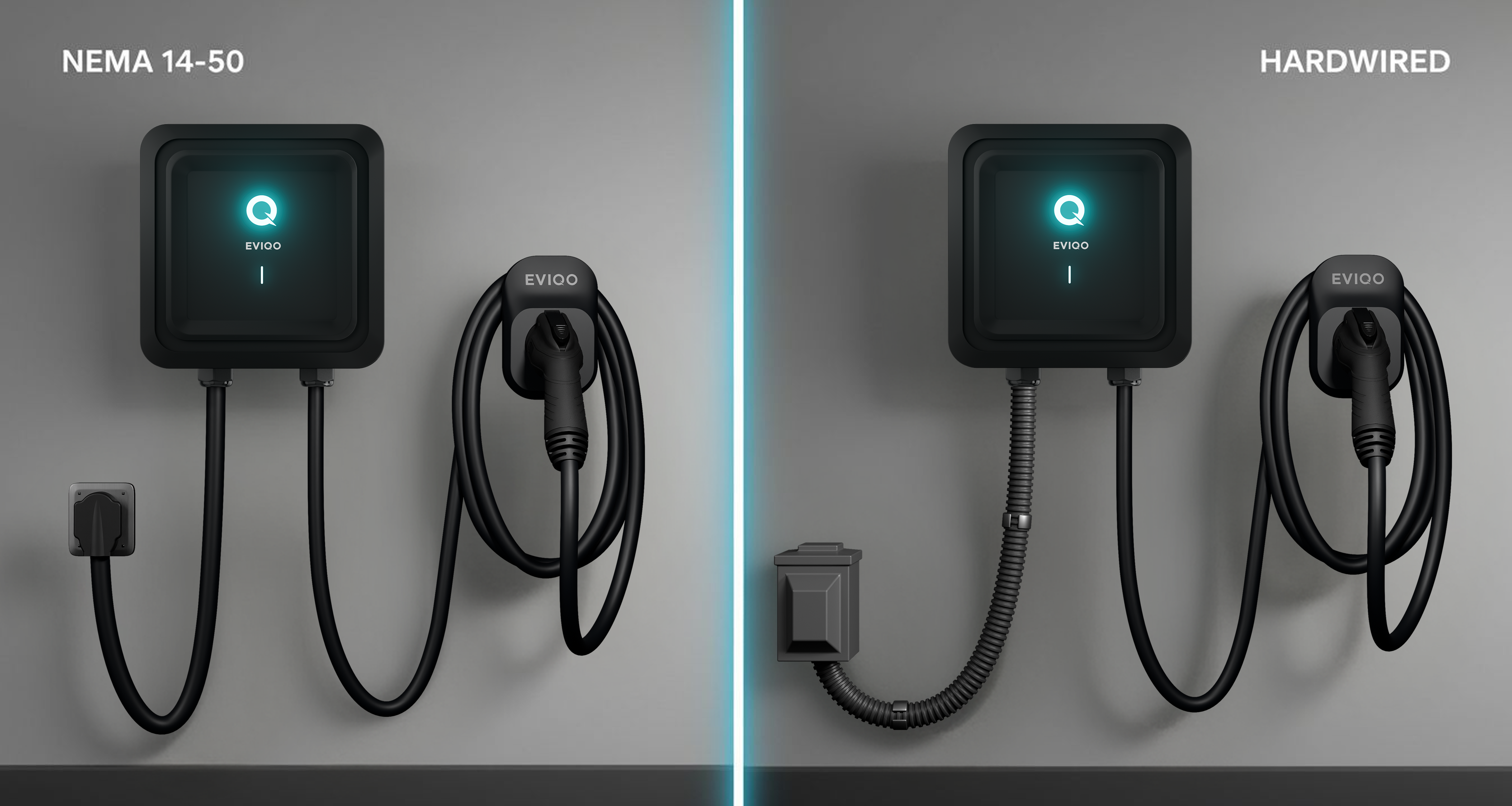
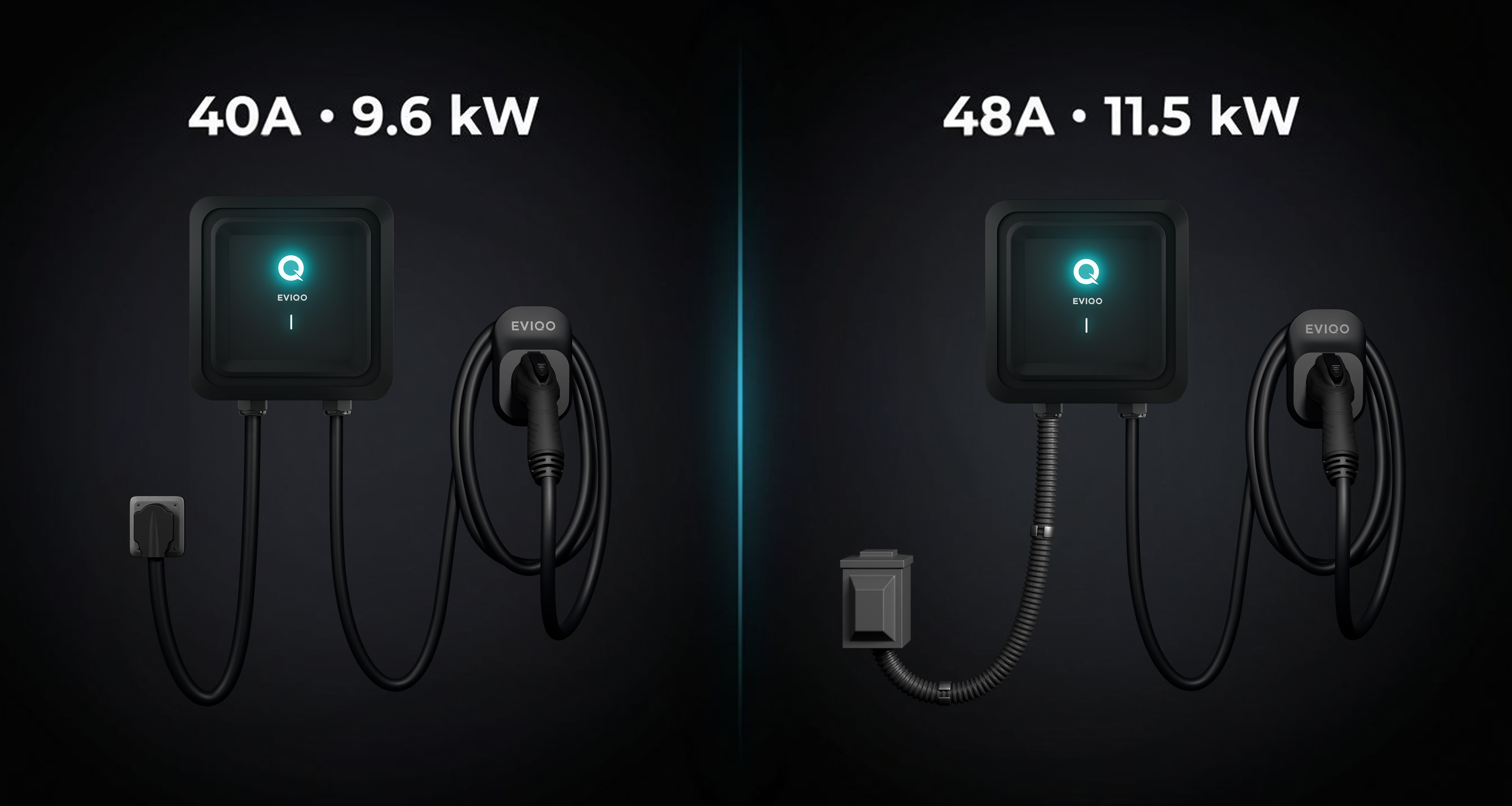
- Amperage: 40A (plug-in NEMA 14-50) or 48A (hardwired). 48A future-proofs better.
- Cable length: 25 feet is the new standard. 18–20 feet is annoying. 30 feet is rare and expensive.
- Outdoor rating: NEMA 4 / IP66 means safe outdoor mount. Anything less is indoor-only.
- Connector type: NACS (Tesla + 2025+ Ford/GM/Hyundai/Rivian) or J1772 (everything else).
- Smart features: WiFi for scheduling, app, monitoring. OCPP for future flexibility.
- Warranty: 3 years from a reputable brand is standard. Less is a red flag.
Compare EVIQO chargers across all four collection hubs →
What doesn’t matter much
- Brand badges (most third-party chargers are made in similar factories)
- “Smart” features you’ll never use (gamification, social sharing)
- Color or aesthetic premium (one-time decision, doesn’t affect daily use)
Labor cost: electricians by region
Labor is the most variable component of installation cost — anywhere from $200 to $1,200 depending on where you live, the complexity, and the electrician’s certifications.
National 2026 labor rates for EV charger installation
| Region | Typical hourly rate | Typical install (3–5 hrs) |
|---|---|---|
| Nashville, Atlanta, Phoenix | $75–$110/hr | $300–$500 |
| Chicago, Dallas, Denver | $90–$130/hr | $400–$650 |
| Boston, Seattle, Portland | $120–$165/hr | $500–$800 |
| NYC, San Francisco, LA | $135–$195/hr | $600–$1,000 |
| Hawaii, Alaska (remote) | $145–$220/hr | $700–$1,200 |
What’s included in standard labor
A typical Level 2 EV charger install (modern 200A panel, garage location, 30 ft wire run) breaks down like this:
| Task | Time |
|---|---|
| Site assessment, load calculation | 30–45 min |
| Pull permit (paperwork only, fees separate) | 15–30 min |
| Run wire from panel to install location | 90–120 min |
| Install junction box or NEMA 14-50 outlet | 30 min |
| Connect to breaker, test circuit | 45 min |
| Mount charger, terminate cable | 30 min |
| Connect car, verify charging | 15 min |
| Customer walkthrough | 15 min |
| Total typical labor | 3.5–5 hours |
What you’ll pay extra for
- Wire run over 50 feet: +$150–$300
- Outdoor installation through wall: +$100–$250
- Working in finished walls (drilling, fishing wire): +$150–$400
- Asbestos or knob-and-tube wiring discovery: +$500–$1,500
- Weekend or after-hours service: +25–50% surcharge
- Same-day installation: +$100–$200
- Inspection coordination service: +$50–$100
How to negotiate labor cost
- Get 3 quotes minimum. Prices vary 40–60% in the same metro. Three quotes typically find the median.
- Ask for itemized estimates. Pure hourly is fine, but itemized “labor + materials” shows you what’s being charged for and where there’s room to negotiate.
- Avoid the same-day-install premium unless you genuinely need it.
- Consolidate with other electrical work. If you’re also adding outlets, doing a panel upgrade, or other work, EV charger install is often a “while we’re here” addition with reduced labor cost.
Wire and material costs
After labor, materials are usually the second-biggest line item.
Wire cost by gauge (2026 prices)
| Wire gauge | Continuous amperage | Price per foot | 50-ft run cost |
|---|---|---|---|
| 6 AWG copper THHN | 40A (NEMA 14-50) | $3.50–$5.00 | $175–$250 |
| 4 AWG copper THHN | 48A (hardwired typical) | $5.50–$7.50 | $275–$375 |
| 2 AWG copper THHN | 80A future-proofing | $8.50–$12.00 | $425–$600 |
Other material costs
| Item | Cost |
|---|---|
| 50A double-pole breaker (NEMA 14-50) | $20–$60 |
| 60A double-pole breaker (hardwired) | $50–$120 |
| GFCI-compatible breaker (outdoor required) | $90–$180 |
| Conduit (per 10 ft) | $5–$15 |
| Junction box | $15–$30 |
| Mounting hardware kit | $10–$25 |
| Outlet NEMA 14-50 + box | $30–$80 |
| Weatherproof “in-use” cover (outdoor) | $25–$60 |
| Misc supplies (clips, marker, tape) | $10–$25 |
Total materials (typical 35-foot installation)
| Setup | Total materials cost |
|---|---|
| NEMA 14-50 plug-in (modest distance) | $200–$400 |
| Hardwired 48A (modest distance) | $350–$600 |
| Hardwired 48A (long run, 80+ ft) | $550–$950 |
Permit and inspection costs (state by state)
Almost every US municipality requires an electrical permit for new 240V circuits. The cost is small but the process matters.
Permit cost ranges by region
| Region | Permit fee | Inspection (if separate) |
|---|---|---|
| Rural Midwest, South, mountain states | $25–$75 | Usually included |
| Suburban Midwest, Texas, Florida | $50–$120 | Often included |
| Suburban California, NY, MA | $100–$200 | $50–$150 |
| NYC, LA, SF | $150–$300 | $75–$200 |
| Very strict municipalities (Berkeley, Marin) | $200–$450 | $100–$250 |
What permits cover and why they matter
A permitted installation includes a post-install inspection by your local electrical authority. The inspector verifies:
- Wire gauge matches breaker size
- Breaker rated for the load
- Grounding properly connected
- GFCI protection where required
- Working clearances at the panel
- Charger mounting height (NEC 625.50)
Skipping the permit saves $50–$300 short-term, but the long-term costs are real:
- Homeowner’s insurance. Unpermitted electrical work can void claims for fire or electrical incidents. Major exposure.
- Resale. When selling, unpermitted modifications often need disclosure. Buyers may demand inspection. Some lenders won’t fund without permit history.
- Warranty. Some charger manufacturers won’t honor warranty on unpermitted installs.
- Code compliance. If a fault later occurs, you’re personally liable for code violations.
The $100 permit pays for itself many times over.
How to actually pull permits
Most US municipalities allow either the homeowner or the licensed contractor to pull the permit. Contractors typically include permit fees in their quote. If you’re DIYing the permitting, expect to:
- Fill out an electrical permit application (usually online)
- Pay the fee ($25–$300 depending on jurisdiction)
- Schedule final inspection after work is complete
- Pass inspection
- Receive permit completion documentation
Allow 3–14 days for the process, depending on jurisdiction backlog.
Panel upgrade costs (when you actually need one)

Older 100A/60A panels may need an upgrade first.
This is where projects can blow past budget. Most homes are fine. Some aren’t.
When you DON’T need a panel upgrade
- Modern home (1990s+) with 200A service and unused breaker slots
- 150A service with mostly gas appliances and unused capacity
- 100A service with conservative load calculation showing >50A free capacity
When you MIGHT need a panel upgrade
- 100A service with all-electric appliances (electric range, dryer, water heater, heat pump)
- 100A service with whole-home AC and an EV charger
- Older homes (1970s–1980s) with potential FPE Stab-Lok or Federal Pacific panels (these have known reliability issues)
- Aluminum wiring (1965–1973 era, has specific install requirements)
When you ABSOLUTELY need a panel upgrade
- 60A service (almost all pre-1970 homes that haven’t been updated)
- Knob-and-tube wiring (pre-1950 in original condition)
- Damaged or obsolete panel (rust, burning, missing labels)
- Service entrance not rated for 200A
Panel upgrade cost ranges
| Scope | Cost range |
|---|---|
| Simple 100A → 200A panel swap | $2,000–$3,800 |
| 100A → 200A with new service entrance | $3,500–$5,500 |
| 60A → 200A (full service upgrade) | $4,500–$8,500 |
| Add 100-amp sub-panel for EV charger | $1,200–$2,500 |
| Replace FPE Stab-Lok panel (urgent safety) | $2,500–$4,500 |
Sub-panel as a cheaper alternative
If your main panel is at capacity but the service entrance is rated 200A, a sub-panel for the EV charger circuit might be $1,000–$2,000 cheaper than a full main panel upgrade. The electrician adds a sub-panel near the install location, feeds it from the main panel with a 60–80A feeder, and creates a dedicated breaker for the EV charger.
Most electricians won’t suggest this unless asked. It’s worth asking specifically.
Federal tax credit: 30% back up to $1,000
The Section 30C Alternative Fuel Vehicle Refueling Property Credit gives you back 30% of qualified expenses, capped at $1,000 for residential installations.
What qualifies as a “qualified expense”
- The EV charger itself (equipment cost)
- Installation labor
- Wire, conduit, and electrical materials
- Permit fees
- Inspection fees
- Equipment rentals during install (lift, drill, etc.)
What doesn’t qualify
- Panel upgrade (this is separate residential infrastructure)
- The EV vehicle itself
- Service contracts or extended warranties
- Future maintenance or repair
- Mobile connector that came with your EV
- Public charging session fees
2026 eligibility requirement: census tract
The credit now requires installation in a low-income or non-urban census tract. The IRS provides a lookup tool — about 67% of US census tracts qualify. Check your specific address before assuming.
How the credit math works
| Scenario | Qualified expenses | 30% credit | Final cost (after credit) |
|---|---|---|---|
| Budget setup: $200 charger + $400 install | $600 | $180 | $420 |
| Typical setup: $400 charger + $800 install | $1,200 | $360 | $840 |
| Premium setup: $700 charger + $1,500 install | $2,200 | $660 | $1,540 |
| Complex setup: $700 + $2,500 install + sub-panel | $4,000 | $1,000 (capped) | $3,000 |
How to actually claim it
- Verify eligibility. Check that your installation site is in a qualifying census tract.
- Save documentation. Charger purchase invoice, installation invoice (electrician’s W-9), permit receipts, inspection completion documentation.
- File Form 8911 with your federal tax return for the year the installation was completed.
- Keep records for 3+ years in case of IRS verification.
Full eligibility details and filing instructions: Section 30C complete guide →
State and utility rebates worth claiming
Beyond the federal credit, many states and utilities offer their own incentives. These stack on top of the federal credit.
Best state programs (2026)
| State | Program | Benefit |
|---|---|---|
| California | TURN Energy Star EV Charger Rebate | Up to $500 off qualifying chargers |
| Colorado | Charge Ahead Colorado | Up to $5,000 commercial (residential varies) |
| Connecticut | EVSE Rebate | $400 toward Level 2 install for income-qualifying households |
| Maryland | EVSE Rebate Program | 40% of cost up to $700 residential |
| Massachusetts | MOR-EV | Up to $4,500 charger + install for income-qualifying |
| New Jersey | Charge Up NJ | $5,000+ varies by program |
| New York | NYSERDA Charge Ready NY | $4,000 toward residential install |
| Oregon | Charge Ahead Rebate | Up to $2,500 plus tax credit |
| Vermont | Drive Electric Vermont | $1,500+ varies |
| Washington | WA EV Tax Credit | State income tax credit up to $500 |
Top utility rebates
| Utility | State | Benefit |
|---|---|---|
| Pacific Gas & Electric (PG&E) | CA | $500 charger rebate + 10% off install |
| Southern California Edison (SCE) | CA | Up to $300 rebate for ENERGY STAR chargers |
| Consolidated Edison (ConEd) | NY | $500–$1,000 toward charger + install |
| Commonwealth Edison (ComEd) | IL | $250 rebate + off-peak rate enrollment |
| Xcel Energy | CO, MN | Up to $500 rebate + EV rate plan |
| Duke Energy | NC, SC | $1,000 rebate for EV-Smart Home program |
| BC Hydro | (BC, but cross-border applicable for some) | Variable |
Action step: Before installing, search your utility’s website for “EV charger rebate” — most offer some incentive. Some require pre-installation enrollment, so check before you buy the charger.
Sample total-cost scenarios for typical homes
Real-world examples showing how the numbers actually work out.
Scenario 1: Suburban Texas home, 200A service, garage install
- Plug-in 40A NEMA 14-50 (EVIQO Gen 2)
- 30 ft wire run from panel to garage
- Modern panel, breaker slot available
- Standard permit process
| Component | Cost |
|---|---|
| Charger | $399 |
| 50A breaker | $40 |
| 6 AWG copper wire (35 ft) | $175 |
| Outlet + box | $50 |
| Labor (3 hours @ $100/hr) | $300 |
| Permit + inspection | $75 |
| Total before credit | $1,039 |
| Less Section 30C (30% capped at $1,000) | -$312 |
| Net cost | $727 |
Scenario 2: Suburban California home, 100A service, outdoor hardwired
- Hardwired 48A NACS (EVIQO Hardwired NACS)
- 45 ft wire run, outdoor wall mount
- Existing 100A service, need sub-panel
- More complex permit
| Component | Cost |
|---|---|
| Charger | $549 |
| Sub-panel + 80A feeder | $1,400 |
| 60A breaker | $90 |
| 4 AWG copper wire (50 ft) | $325 |
| Junction box + outdoor weatherproofing | $80 |
| Labor (5 hours @ $150/hr) | $750 |
| Permit + inspection | $150 |
| Total before credit | $3,344 |
| Less Section 30C ($1,000 cap) | -$1,000 |
| Less PG&E rebate | -$500 |
| Net cost | $1,844 |
Scenario 3: Older Northeast home, 60A service, panel upgrade required

An older home’s panel upgraded to 200A before install.
- Hardwired 48A (any model)
- 60A → 200A panel upgrade required first
- Indoor garage installation
- 40 ft wire run from new panel
| Component | Cost |
|---|---|
| Panel upgrade 60A → 200A | $6,500 |
| Service entrance upgrade | $1,200 |
| Charger | $499 |
| 60A breaker + 4 AWG wire (45 ft) | $360 |
| Junction box | $40 |
| Labor (8 hours @ $130/hr) | $1,040 |
| Permits + inspection | $200 |
| Total before credit | $9,839 |
| Less Section 30C ($1,000 cap) | -$1,000 |
| Less MOR-EV (income-qualified residential) | -$2,000 |
| Net cost | $6,839 |
Most homeowners are scenario 1 or scenario 2. Scenario 3 happens to maybe 5–8% of buyers and is the reason “EV charger installation cost” has such a wide range.
Use our EV charger cost calculator for an estimate specific to your home’s situation.
Hidden costs nobody tells you about
The line items that don’t appear in initial quotes:
1. Discovery surprises
The electrician arrives, opens the panel, and finds: - Existing aluminum wiring (1965–1973): $500–$1,200 to add anti-oxidant compound and proper terminations - Knob-and-tube wiring discovered behind walls: $1,500–$5,000 to update - Asbestos in walls or insulation: $800–$2,500 abatement before drilling - Active panel issues (corrosion, water damage): $2,000+ unscheduled panel work
2. Utility connection or upgrade requirements
If your charger’s installed amperage triggers utility notification thresholds, your utility may require: - Smart meter installation (often free, sometimes $200) - Service drop upgrade (utility’s pole to your meter): variable but often utility-covered - Time-of-use rate enrollment requirements
3. Wire route surprises
The “30-foot run” looks 30 feet on a measuring tape but the wire path goes: - Through 2 wall cavities (extra labor) - Around HVAC ducting (drilling, fishing) - Through insulation that needs to be carefully replaced - Add: $200–$500 in extra labor
4. Charger installation height/clearance
NEC code requires 18” minimum clearance below the unit. If your wall doesn’t have it (radiator, vent, baseboard), expect: - Bracket installation: $50–$100 - Wall reframing if needed: $200–$500 - Repositioning to a different wall: variable
5. Concrete or finished surface drilling
NEMA 14-50 outlet on a finished basement wall? Add: - Diamond core drill bit rental: $50–$120 - Patching and painting: $50–$150 - Anchor bolt replacement: $20–$40
6. Permit delay costs
Some jurisdictions require pre-installation inspection. If yours does: - Two electrician trips needed: +$100–$250 - Possible 1–3 week delay before final install
7. Special weatherproofing for outdoor installs
- Higher-grade outdoor box: $40–$80
- Weatherproof “in-use” cover: $30–$60
- Conduit weatherproofing: $50–$100
- Specific GFCI breaker (EV-compatible): $90–$180
DIY vs hiring a licensed electrician
This question gets asked a lot. The honest answer:
When DIY is reasonable
- You’re a licensed electrician yourself
- You have 10+ years of practical residential electrical experience
- Your jurisdiction allows owner-installer permits (some do, many don’t)
- The installation is a simple NEMA 14-50 with a clear wire path
- You’re 100% certain you can self-inspect to code
When DIY is risky
- You’re “handy” but not formally trained
- Your jurisdiction requires licensed contractor permits
- The installation requires hardwiring directly to a panel
- You’re not 100% certain about wire gauge sizing for your conditions
- You haven’t done a real load calculation
The honest math on savings
- DIY equipment cost: ~$70 (basic tools)
- DIY material cost: ~$200 (wire, breaker, fittings)
- DIY hours: 6–12 for a first-timer (vs. 3–5 for a pro)
- DIY hourly equivalent saving: $40–$100/hr (your labor)
- DIY total saving vs paid install: ~$300–$700
Risks worth considering
- Code violations that void permits, insurance, future warranty
- Code violations that fail inspection (forcing rework + new permit)
- Improper grounding that could shock or kill someone (worst case)
- Inadequate wire gauge that overheats and starts a fire
- Improperly torqued connections that arc and burn
A licensed electrician is $300–$700 of insurance against $50,000+ of potential downside. Worth it for almost everyone.
For Level 2 EV charger installations specifically, EVIQO partners with Treehouse Pro — a network of EV-charger-certified electricians with flat-rate transparent pricing, available in most US metros. Typical turnaround: 5–10 business days from purchase.
How to actually save money on installation
After analyzing thousands of installs, these tactics consistently reduce cost:
- Get 3 quotes, not 1. Prices vary 40–60%. Three quotes finds the median.
- Bundle electrical work. If you need other electrical work done (new outlet, ceiling fan, panel maintenance), bundling EV charger install drops the marginal labor cost.
- Schedule mid-week. Most electricians charge less Tuesday–Thursday than weekends.
- Skip the same-day install premium. A 5–10 day wait saves $100–$200.
- Pull your own permit. Saves the contractor’s permit-pulling time ($50–$100).
- Buy your charger separately and have it ready. Skips electrician’s “delivery service” charge ($50–$100) and ensures you’ve researched the right model.
- Use the federal tax credit. $300–$1,000 back, simple to claim.
- Check state and utility rebates. Stack with federal credit for additional savings.
- Choose NEMA 14-50 if you’re uncertain. Lower install cost; convertible to hardwired later if you want.
- Don’t oversize wire “just in case.” A 6 AWG run for 40A vs 4 AWG for 48A is a clear cost difference. Choose your charger amperage first, then wire to it.
Frequently asked questions
What’s the average cost to install a Level 2 EV charger?
National 2026 average is $900–$1,800 total (charger + installation) for a typical modern home with 200A service. After the federal tax credit, the typical out-of-pocket cost is $630–$1,260. Use our calculator for a more personalized estimate.
Is installing an EV charger worth it?
For most homeowners with 8,000+ annual EV miles, yes. The break-even on a $1,500 total install vs. public DC fast charging happens in 8–12 months at average usage. After that, you’re saving roughly $100/month vs. public charging.
Can I install an EV charger myself?
Technically yes (in some jurisdictions) but the realistic answer is no for most people. Licensed electrician work is $300–$700 cheaper than the risks of DIY-induced code violations, insurance complications, or unsafe installations.
How long does installation take?
Typical install is 3–5 hours of electrician time, scheduled over 1–2 weeks (permit processing + install date). Complex installs (sub-panel, long wire run, outdoor weatherproofing) can take 6–10 hours.
Will my homeowner’s insurance rate go up?
No — but you do need to inform your insurer of the new EV charger installation. Most insurers don’t charge extra for this, but unpermitted installations can void claims if a fault later occurs.
What about apartment renters or condo owners?
Renters generally can’t install hardwired chargers (it’s the owner’s property). NEMA 14-50 plug-in chargers can sometimes work with landlord approval — they’re portable. For condos, check your HOA rules — most allow EV chargers in deeded parking with notice. Some jurisdictions have “Right to Charge” laws making this easier.
Do I need a separate circuit just for the EV charger?
Yes. NEC code (Article 625) requires a dedicated 240V circuit for any Level 2 EV charger. Shared circuits with other appliances are not allowed at this amperage.
What if my electrician finds something wrong with my existing wiring?
This is what discovery surprises feel like. Common findings: aluminum wiring needs anti-oxidant treatment, old panel needs to be replaced first, asbestos in walls. Get specific quotes for any additional work — these aren’t “surprises” the electrician can ignore, they’re things you’d want fixed anyway.
Can I install multiple EV chargers at once?
Yes, but you’ll need either: (1) two separate circuits, each rated for the respective charger, or (2) a load management system that shares one larger circuit between both chargers. Option 2 is cheaper but requires the chargers to support load management protocols (OCPP).
Is there a way to install for less than $500 total?
Yes, but only in narrow circumstances: existing NEMA 14-50 outlet from a previous EV/RV setup, charger purchased on deep discount, DIY install (if legally allowed and you’re trained), and skip the permit (not recommended). The realistic minimum for most installs is $700–$900.
How do utility rebates work?
Most utility EV charger rebates require: (1) purchasing an ENERGY STAR-certified charger, (2) enrolling in a time-of-use rate plan, (3) submitting proof of purchase after install. Refund check typically arrives in 4–8 weeks. Application before install is sometimes required.
What if the federal tax credit doesn’t apply to my address?
If your installation site isn’t in a qualifying census tract, the federal Section 30C credit doesn’t apply. However, you can still claim state and utility rebates. Most US homeowners (roughly 67%) are in qualifying tracts — check the IRS lookup at our tax credit guide.
Is the EV charger installation cost tax-deductible?
Yes, in the form of the Section 30C federal tax credit (different from a deduction — credits reduce taxes dollar-for-dollar). Some states also offer income tax credits for EV infrastructure. Standard installation labor as a “home improvement” is not tax-deductible unless your home is a business property.
Make informed decisions about your installation cost
Before you commit to an EV charger and electrician, do these four things:

EVIQO Level 2 Charger — 40A Plug-In (J1772)
Plugs into a NEMA 14-50 outlet — 9.6 kW, up to ~37 mi/hr. The simplest fast home charging for any non-Tesla EV. 25 ft cable, IP66, WiFi app. Rated 4.92★.
$470.99$570.00Shop 40A Plug-In →

EVIQO Level 2 Charger — 48A Hardwired (J1772)
Hardwired for the full 11.5 kW — up to ~44 mi/hr. Best for long commutes and outdoor mounting. NEMA 4/IP66, 25 ft cable, 3-yr warranty. Rated 4.91★.
$430.99$509.00Shop 48A Hardwired →
- Get a load calculation from a licensed electrician ($100–$200) to know what your panel actually supports.
- Get 3 quotes for the install (free, takes a few days).
- Verify your census tract eligibility for the federal tax credit (free, 2 minutes).
- Check your utility’s rebate program (free, 5–10 minutes).
This four-step process typically saves $200–$700 on total installation cost. Worth the hour.
Get a personalized install estimate via Treehouse Pro → (flat-rate pricing, EV-certified electricians)
For specific charger recommendations based on your budget and electrical situation, browse EVIQO’s collection of Level 2 chargers or contact our team — we respond within 2 business hours with charger and install advice for your specific home.
For more product Q&A and installation FAQs, visit the EVIQO Knowledge Base or read verified expert reviews.


Leave a comment
This site is protected by hCaptcha and the hCaptcha Privacy Policy and Terms of Service apply.