

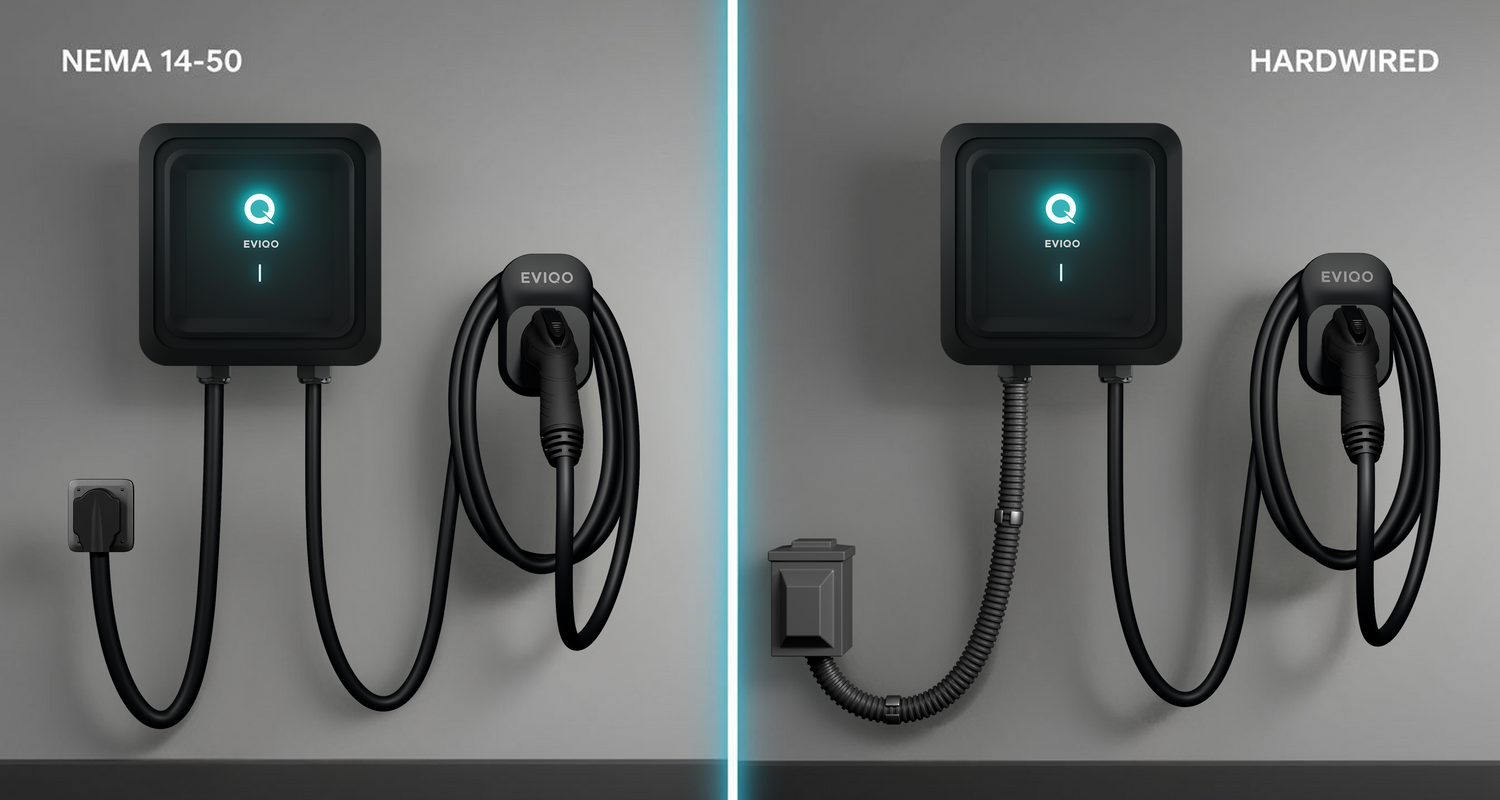
For most homeowners a NEMA 14-50 plug-in charger is the simplest, most flexible choice — it installs fast, comes with you if you move, and delivers 40A (9.6 kW), enough to fully charge any EV overnight. Choose hardwired if you want the full 48A (11.5 kW) for ~25% faster charging, plan to stay 5+ years, or are mounting outdoors. Both are equally safe, both qualify for the federal tax credit, and EVIQO makes both.
When you’re buying a Level 2 home EV charger in 2026, one decision has more long-term impact than any other spec on the box: plug-in (NEMA 14-50) or hardwired. It’s not about which is “better” — both are perfectly safe, both deliver real Level 2 charging speeds, and both have devoted owners. But each fits a different kind of household, and picking wrong can mean paying for an upgrade in 18 months when you realize you wanted the other one.
This guide breaks down exactly what separates the two installation methods, what each one costs in 2026, when to pick which, and the electrical-code details most people only discover at inspection time.
Quick comparison: NEMA 14-50 vs hardwired at a glance
Before we dig into the nuance, here’s the side-by-side that answers most reader questions:
| Feature | NEMA 14-50 (Plug-In) | Hardwired |
|---|---|---|
| Max amperage | 40A typical (8 kW at 240V) | 48A typical (11.5 kW at 240V) |
| Charging speed | ~30 mi / hr | ~37 mi / hr |
| Installation type | Plug into existing outlet | Wired directly into electrical panel |
| Portability | Removable, take to new home | Permanent fixture |
| Breaker size | 50A double-pole | 60A double-pole (typical) |
| Code requirements (NEC 625) | GFCI required at outlet | Internal GFCI in charger acceptable |
| Typical install cost (2026) | $300–$900 (outlet only) | $600–$1,800 (direct wire) |
| Federal tax credit (Section 30C) | Yes (30%, up to $1,000) | Yes (30%, up to $1,000) |
| Outdoor rating | Requires weatherproof outlet box | NEMA 4 / IP66 charger handles directly |
If you walked away with just this table, you’d already make a smart decision. Below, we’ll explain why each row matters.
NEMA 14-50: how the plug-in setup actually works

A NEMA 14-50 outlet versus a hardwired junction box.
A NEMA 14-50 is a heavy-duty 240V/50A outlet — the same kind used for electric ranges, RVs, and welders. It’s been the standard “EV-friendly” outlet for over a decade, and it remains the most popular way to charge at home for one obvious reason: it’s flexible.
You plug your EV charger into the outlet. If you move, you unplug it and take it with you. If you upgrade your charger in a couple of years, the outlet stays put. It’s the same logic as renting versus buying a house — fewer commitments, easier exit.
What “NEMA 14-50” actually means
The number tells you the outlet specification:
- NEMA: National Electrical Manufacturers Association — the body that standardizes US electrical plug shapes
- 14: A 4-prong configuration (two hot wires, one neutral, one ground)
- 50: The maximum current rating in amps
The “14-50” specifically refers to a 4-pin grounded outlet rated for 50A continuous service — but per NEC code (Article 625.41), EV chargers can only draw 80% of their breaker’s rating continuously. So a 50A breaker safely supplies a 40A continuous charge, which translates to about 9.6 kW of charging power at 240V.
When NEMA 14-50 is the right call
- You rent or might move in 1–3 years. Take the charger with you.
- Your home’s electrical panel is older. A new 240V plug outlet is much simpler than rewiring through walls.
- You want flexibility for the future. Charger broken in 5 years? Just unplug, replace, plug in. No electrician needed.
- Your electric service is exactly 100A. A 50A breaker is easier to fit into a smaller service.
- You like the visible “I unplug it when I leave for vacation” reassurance. Some homeowners just prefer this.
💡 Did you know? The same NEMA 14-50 outlet that powers your EV charger can also power an electric range or RV hookup. If you’re already installing one of those, the wiring is identical — and you can use the outlet for whatever’s plugged in that month.
When NEMA 14-50 doesn’t make sense
The big limitation: 40A continuous max. Even if you buy a 48A-rated charger, plugged into a NEMA 14-50, it’ll only deliver 40A. If you have a long-range EV that you regularly drain to <20%, those extra 8 amps add about 15% faster overnight charging — and after a year of driving, that compounds.
The other limit: outdoor weatherproofing. NEMA 14-50 outlets installed outdoors need a weatherproof “in-use” cover and a GFCI breaker (NEC 625.54). The GFCI breakers commonly trip when they shouldn’t with high-power loads like EV chargers — this is a documented industry issue. Most outdoor installations end up needing replacement GFCI breakers within 1–2 years.
For garage installations, this isn’t an issue. For outdoor wall-mount installations, hardwired is often the better choice.
Hardwired: when permanent installation makes sense
A hardwired EV charger doesn’t have a plug at all. The charger’s internal wires connect directly to a junction box on your wall, which connects directly to a circuit breaker in your electrical panel. There’s no outlet, no plug, no removable interface.
This sounds restrictive, and it is — but for many homeowners, it’s the better tradeoff.
Why hardwired delivers more power
Without the NEMA 14-50 outlet limit, a hardwired EV charger can use a larger breaker. With a 60A breaker, the charger can deliver 48A continuous (the 80% rule again) — equivalent to 11.5 kW at 240V.
That extra power delivers measurable advantages:
- 20–25% faster charging. For a 100 kWh battery (Rivian R1T, Hummer EV, GMC Sierra EV), that’s about 1.5 hours less per full charge.
- Less time tethered overnight. If you commute 80+ miles daily, you’ll appreciate the extra speed when there are unexpected back-to-back trips.
- Better future-proofing. As EVs get bigger batteries (the 2026 Cybertruck has 123 kWh; 2027 GMC Sierra Denali EV has 205 kWh), 48A becomes the better long-term spec.
When hardwired is the right call
- You’re a homeowner planning to stay 5+ years. The “I might move” argument doesn’t apply.
- You drive a long-range EV (75+ kWh battery). Faster overnight charging is genuinely useful.
- You want outdoor installation. A NEMA 4 / IP66 hardwired unit is more reliable than an outdoor NEMA 14-50 outlet.
- You want maximum reliability. Fewer connection points = fewer things to go wrong.
- Your electrical panel is modern (200A service). Adding a 60A circuit is straightforward.
- You charge a Tesla Cybertruck or other high-current EV. These benefit measurably from 48A.
When hardwired doesn’t make sense
- You rent. Don’t install hardwired equipment in a property you don’t own.
- You might move in 1–3 years. A hardwired install stays with the house.
- Your panel is older (60A or 100A service). You may need a costly panel upgrade first.
- You don’t have an electrician you trust. Hardwiring is genuinely a job for a licensed pro — DIY hardwiring is both code-illegal and unsafe.
Browse EVIQO hardwired EV chargers →
Speed difference: does hardwired actually charge faster?
Yes — but maybe not as much as you’d think. Here’s the math.
| Setup | Amperage | Power | Miles added per hour | 0–100% Tesla Model 3 LR |
|---|---|---|---|---|
| NEMA 14-50 (plug-in) | 40A | 9.6 kW | ~30 mi/hr | 7.5 hours |
| Hardwired | 48A | 11.5 kW | ~37 mi/hr | 6.2 hours |
For a Tesla Model 3 Long Range (75 kWh battery), the speed difference is about 1.3 hours from empty to full. For everyday driving where you’re topping off from 50% to 90%, the difference is closer to 25 minutes.
That sounds like nothing — until you realize that’s roughly 9 extra hours of charging time per month that hardwired saves you. Over the lifetime of your charger (8–10 years), it adds up to nearly 4 days of additional EV availability.
For longer-range EVs (Cybertruck, Lightning Extended Range, Lucid Air), the speed gap widens. A Cybertruck (123 kWh) takes about 13 hours to fully charge on NEMA 14-50 vs about 10.5 hours hardwired. That’s a real difference if you’re charging on overnight off-peak rates that end at 6 AM.
Real installation costs in 2026 (with regional ranges)
National 2026 averages compiled from licensed-electrician quotes across major US metros. Your actual cost will vary based on your panel’s proximity to your install location, your local labor rates, and your panel’s current capacity.
NEMA 14-50 installation (plug-in setup)
| Cost component | Range |
|---|---|
| Electrician labor (2–4 hours) | $200–$600 |
| 50A double-pole breaker | $20–$60 |
| 6 AWG copper wire (per ft) | $4–$8 |
| NEMA 14-50 outlet + box | $30–$80 |
| Outdoor weatherproof cover (if needed) | $40–$80 |
| Local permit | $25–$200 |
| Inspection (if required) | $50–$150 |
| TOTAL (typical garage install, ≤25 ft wire) | $400–$900 |
| TOTAL (long wire run, 75+ ft from panel) | $700–$1,400 |
Hardwired installation (direct-wire setup)
| Cost component | Range |
|---|---|
| Electrician labor (3–5 hours) | $300–$900 |
| 60A double-pole breaker | $50–$120 |
| 4 AWG copper wire (per ft) | $5–$11 |
| Junction box + conduit | $25–$60 |
| Local permit | $25–$200 |
| Inspection (if required) | $50–$150 |
| TOTAL (typical garage install, ≤25 ft wire) | $600–$1,400 |
| TOTAL (long wire run, 75+ ft from panel) | $900–$1,800 |
What drives the upper end of the range
- Panel upgrade required. If your home has 100A service or less, you may need to upgrade to 200A first. This alone is $2,000–$4,500 and is separate from charger install cost.
- Long wire run. Every additional 25 feet of wire adds roughly $100–$200 in materials plus labor.
- Existing panel is full. If you need a sub-panel to accommodate the new circuit, add $400–$900.
- California, Massachusetts, NYC metros. Labor here typically runs 30–50% above national averages.
Use our EV charger cost calculator for a more personalized estimate based on your specific situation.
Permit and inspection requirements by state
Most US municipalities require an electrical permit for any new 240V circuit — including both NEMA 14-50 and hardwired EV charger installations. The cost is small but the process matters.
When you need a permit (almost always)
- Adding any new dedicated 240V circuit
- Installing a NEMA 14-50 outlet on a new circuit
- Hardwiring any device pulling 30+ amps
- Adding capacity to your electrical panel
When you might not need a permit (rare)
- A licensed electrician declares the work “minor” (varies by jurisdiction)
- Some rural unincorporated areas don’t require permits
- Solar-tied EV charger installs may follow solar permit rules (consolidation possible)
Inspection process
After permitted work is complete, the local electrical authority sends an inspector. Common checks:
- Breaker sizing matches charger requirements
- Wire gauge appropriate for amperage (4 AWG for 48A continuous, 6 AWG for 40A)
- Grounding properly connected
- GFCI protection where required (outdoor NEMA 14-50, certain hardwired setups)
- Working clearance maintained around panel
- Charger mounting secure and at code-required height
Skip the inspection at your peril. Unpermitted EV charger installs can void your homeowner’s insurance, create issues when selling the property, and — if a fault causes a fire — leave you fully liable. The $50–$200 permit fee is genuine investment.
💡 Did you know? Some utilities (PG&E in California, ConEd in NY, ComEd in IL) require notification when you add an EV charger that pulls 40A+. This isn’t the same as a permit — it’s a heads-up to the utility so they can monitor demand. Failing to notify can sometimes void utility rebates.
Electrical service: does your panel support either option?
Before deciding NEMA 14-50 vs hardwired, you need to know what your panel can handle. Check the main breaker — the big switch at the top of your electrical panel. The number printed on it (60, 100, 150, 200, or 400) is your service capacity.
60A service (older homes, pre-1970)
You probably need to upgrade your service before installing any Level 2 EV charger. Total connected load almost certainly exceeds capacity once you add a 40A+ EV charger.
Recommendation: Panel upgrade ($2,000–$4,500), then either install.
100A service (mid-century homes, 1960s–1980s)
Marginal. If your home is all-electric (electric range, dryer, heat pump), you’re probably maxed out. If you have natural gas appliances, you might have room for NEMA 14-50 at 40A.
Recommendation: Get a load calculation from a licensed electrician (typically $150–$300). They’ll tell you what’s safely possible. Often NEMA 14-50 fits; hardwired 48A often doesn’t.
150A or 200A service (most modern homes, 1990s+)
Both options work without panel upgrade. Choose based on your other priorities (move flexibility, charging speed, install location).
400A service (large new construction)
Both options work, plus you have headroom for future high-capacity additions like solar batteries.
The future-proofing argument
If you’re buying an EV charger today and expect to keep it 8–10 years, what’s the bet on the future?
Battery sizes are growing. In 2020, the average BEV had a 60 kWh battery. In 2025, it’s 80 kWh. By 2030, projections put the average at 95 kWh, with high-end vehicles (Cybertruck, Sierra Denali EV, Lightning Pro+) routinely exceeding 120 kWh.
A 40A charger that takes 6 hours to fully charge a 2025 EV will take 9 hours to charge a 2030 EV. A 48A charger absorbs that growth more comfortably.
EV adoption is accelerating. US BEV market share is projected to rise from 7.9% (2025) to 22.7% (2030), per S&P Global Mobility forecasts. More EVs means more chargers in service, more competition for off-peak utility windows, more reason to charge fast when you can.
Connector standards are settling. With Tesla’s NACS connector becoming the North American standard (Ford, GM, Rivian, Hyundai all confirmed transitions through 2025–2026), home chargers are getting more compatibility, not less. NEMA 14-50 and hardwired both stay relevant — the standard isn’t changing.
The pattern: if you’re buying for the long haul, hardwired’s faster speeds become more useful over time, not less.
Federal tax credit eligibility for both setups
Both NEMA 14-50 plug-in and hardwired EV charger installations qualify for the Federal Section 30C Alternative Fuel Vehicle Refueling Property Credit — up to 30% of qualified expenses, capped at $1,000 for residential installations.
What counts as “qualified expenses”:
- The EV charger itself (equipment cost)
- Installation labor
- Wiring and electrical materials
- Permits required for the installation
What does NOT qualify:
- Panel upgrades (separate situation)
- The mobile connector that came with your EV
- Public charging fees
- Subsequent service calls or repairs
Important 2026 eligibility update: The credit now requires the installation site to be in a low-income or non-urban census tract. About 67% of US census tracts qualify. Check your address eligibility at our tax credit guide before claiming.
If you spend $1,200 on a charger and $700 on installation ($1,900 total), and your tract qualifies, your federal tax credit is 30% × $1,900 = $570.
This is a credit (reduces tax owed), not a deduction (reduces taxable income) — so it’s worth its full face value if you owe at least that much in federal income tax.
Common mistakes to avoid
After surveying thousands of EV charger installations, these are the patterns we see going wrong:
- 1. Buying a 48A-rated charger and plugging into NEMA 14-50. You’ll only get 40A out of it. Either buy a 40A-max plug-in model, or switch to hardwired installation. Don’t pay for capability you can’t use.
- 2. Skipping the load calculation. “My electrician said it’ll be fine” without doing the calculation isn’t reliable. Even pros sometimes underestimate combined loads — especially in homes with electric ranges + heat pumps + EVs. Demand the actual calculation in writing.
- 3. Installing outdoor NEMA 14-50 without GFCI accommodation. NEC code requires GFCI for outdoor 240V outlets. Standard GFCI breakers nuisance-trip with EV chargers. The solution is a “GFCI-compatible” or “Type B” GFCI breaker that’s tolerant of the charger’s leakage current. Most electricians don’t carry these by default.
- 4. Choosing hardwired in a rental. If you don’t own the property, hardwired equipment becomes the property owner’s once installed. Document this in writing if you plan to take the charger with you (which is rarely feasible).
- 5. Mounting too low or in a path. NEC code requires 18 inches minimum clearance below the unit, 18 inches to the sides. Check before mounting — moving a hardwired unit is a multi-hour electrician job.
- 6. Going cheap on wire gauge. A 4 AWG wire run costs about $4–$5 per foot. A 6 AWG wire run costs about $3–$4. The savings on 50 feet of wire is maybe $40. The voltage drop from undersized wire over long runs will cost you 1–3% of charging efficiency for the life of the charger. Spend the $40.
Decision matrix: which fits your situation?

Quick decision guide: which install fits your situation.
| Your situation | Best choice |
|---|---|
| Renting an apartment with garage access | NEMA 14-50 (take it when you leave) |
| Homeowner, plan to stay 1–3 years | NEMA 14-50 |
| Homeowner, plan to stay 5+ years | Hardwired |
| Driving a 75 kWh+ EV (Model Y LR, Mach-E ER, Bolt, ID.4) | Either works — pick on flexibility vs speed |
| Driving a 100 kWh+ EV (Cybertruck, R1T, Sierra EV, Lightning) | Hardwired for faster charging |
| Outdoor installation | Hardwired (NEMA 4 / IP66 unit) |
| Indoor garage installation | Either works |
| Older home, 100A service | NEMA 14-50 (if load calc allows) |
| Modern home, 200A service | Either works |
| Tight budget, want lowest install cost | NEMA 14-50 |
| Already planning a panel upgrade or sub-panel | Take advantage with hardwired |
| Plans to add second EV in next 2 years | Hardwired with 60A circuit + load management |
Frequently asked questions
Can I switch from NEMA 14-50 to hardwired later?
Yes, but you’ll pay roughly $400–$700 to do the conversion: removing the outlet, installing a junction box, swapping the breaker (50A → 60A), and potentially upsizing the wire (6 AWG → 4 AWG) if your charger supports it. If you think there’s a 50%+ chance you’ll want hardwired within 5 years, install hardwired upfront and save the conversion cost.
Is NEMA 14-50 safe for outdoor use?
Yes, with proper weatherproofing. You need an outdoor-rated outlet box, a weatherproof “in-use” cover (the kind that protects the plug when something is plugged in), and a GFCI breaker compatible with EV chargers (most basic GFCI breakers nuisance-trip — get a Type B). Quality matters here — cheap weatherproof boxes fail in 2–3 winters.
Does hardwiring void the warranty?
No. Most EV charger manufacturers (including EVIQO) explicitly support both NEMA 14-50 and hardwired installation. Hardwiring with a licensed electrician fully maintains your EVIQO 3-year warranty. Hardwiring done by an unlicensed person can void it.
What size wire do I need?
For 40A continuous (NEMA 14-50): 6 AWG copper. For 48A continuous (hardwired): 4 AWG copper. Always copper, not aluminum, for EV chargers — aluminum has thermal expansion issues at the high currents EV chargers deliver. Distance matters too: runs over 100 feet need to be upsized by one gauge to prevent voltage drop.
Can I install either myself?
NEMA 14-50: technically possible if you have electrical experience, code knowledge, and your jurisdiction allows owner-installer permits (many don’t). Hardwired: realistically requires a licensed electrician because it integrates with your panel directly. Either way, the $300–$600 you save is rarely worth the safety, code, and warranty risks. Plus, an unpermitted installation can void homeowner’s insurance.
For hardwired installation specifically, EVIQO partners with Treehouse Pro — a national network of certified EV charger installers with transparent pricing. Available in most US metros, typical install scheduled within 5–10 business days of order.
Will hardwired work with future EVs I haven’t bought yet?
Yes, with one caveat: hardwired chargers don’t care about your specific EV — they deliver 240V AC to whatever’s plugged in via the J1772 or NACS connector. The charger handles the negotiation with the car. As long as your charger has the right connector (J1772 covers all non-Tesla EVs; NACS covers Tesla and post-2025 Ford/GM/Hyundai/Rivian), it works with any current and future EV.
What if my electrical panel is full?
You have three options: install a “load management” system that allows the new circuit to share capacity with existing circuits (about $400–$800), install a sub-panel (about $500–$1,500), or upgrade to a larger main panel (about $2,000–$4,500). Get quotes for all three before committing.
Are there utility rebates for one type vs the other?
Most utility EV charger rebates (PG&E, ConEd, ComEd, Xcel) treat NEMA 14-50 and hardwired the same — the rebate is on the charger purchase, not the install type. A few utilities offer extra rebates for hardwired installations because they’re more permanent and signal long-term EV commitment. Check your local utility’s specific program.
Can my home’s electrical service handle a NEMA 14-50 + hardwired EV charger at the same time?
This is rare but happens with multi-EV households. The answer depends on your panel’s capacity and load profile. With 200A service, charging both at full power is usually fine. With 100A service, you’d want a load management system that throttles one charger when the other is in use. Talk to an electrician — this is exactly the load calculation question they’re built to answer.
Does the federal tax credit work for both install types?
Yes. As of 2026, Section 30C covers up to 30% of qualified expenses (capped at $1,000 residential) for either install type. The credit is identical — only the underlying expenses differ. See our Section 30C guide for full eligibility details.
What’s the resale value impact of each?
NEMA 14-50: minimal impact — buyers see “240V outlet, EV ready.” Hardwired with a unit installed: positive value if the unit is included; neutral if you take it. A 2024 NAR (National Association of Realtors) survey found EV-ready homes sell 2.7% faster than equivalent non-EV homes, regardless of install type.
Choose the right EV charger for your installation type
If you’ve decided on NEMA 14-50 plug-in installation, browse EVIQO’s Plug-In NEMA 14-50 chargers — all rated for 40A continuous with 25-foot cables and 3-year warranty.

EVIQO Level 2 Charger — 40A Plug-In (J1772)
Plugs into a NEMA 14-50 outlet — 9.6 kW, up to ~37 mi/hr. The simplest fast home charging for any non-Tesla EV. 25 ft cable, IP66, WiFi app. Rated 4.92★.
$470.99$570.00Shop 40A Plug-In →

EVIQO Level 2 Charger — 48A Hardwired (J1772)
Hardwired for the full 11.5 kW — up to ~44 mi/hr. Best for long commutes and outdoor mounting. NEMA 4/IP66, 25 ft cable, 3-yr warranty. Rated 4.91★.
$430.99$509.00Shop 48A Hardwired →
If you’re going hardwired, our Hardwired 48A chargers deliver the full 11.5 kW with NEMA 4 / IP66 outdoor rating and the same warranty. For installation, EVIQO partners with Treehouse Pro — certified electricians with EV-charger-specific training, transparent flat-rate pricing.
Not sure which is right? Check our installation guide, browse verified expert reviews, or dig into the EVIQO Knowledge Base for installation FAQs. Contact our team — we’ll help you match the charger to your home in 5 minutes.


Leave a comment
This site is protected by hCaptcha and the hCaptcha Privacy Policy and Terms of Service apply.