

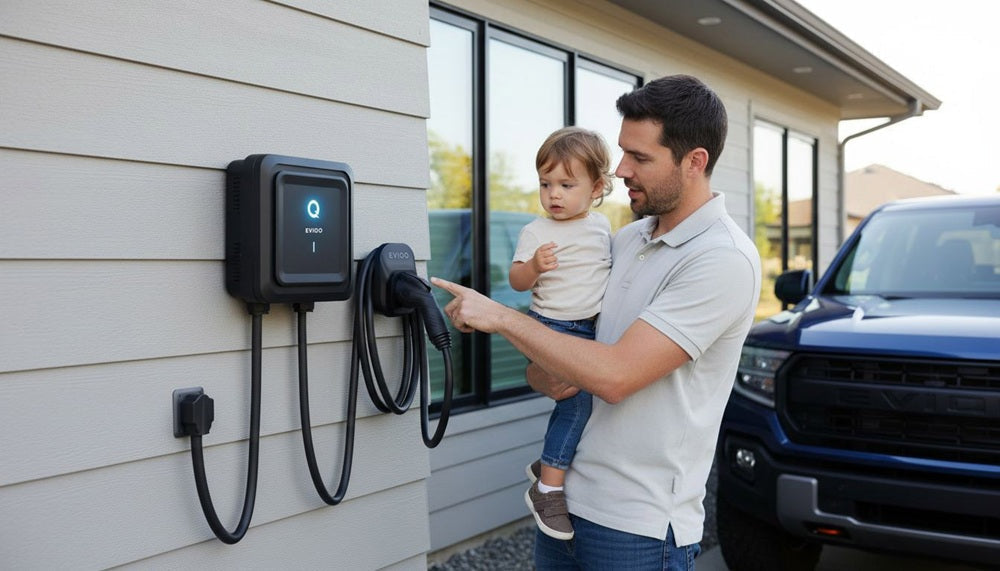
Everything that separates the best home EV charger from a mediocre one in 2026 — charger types and levels, the seven specs that actually matter, NACS vs. J1772, real installation costs, the 30% federal tax credit, and our top Level 2 picks for every electric vehicle.

Finding the best home EV charger in 2026 comes down to one thing: matching the right Level 2 charging station to your car, your electrical panel, and how you actually drive. More than 80% of EV charging happens at home, so the unit on your garage wall matters far more than any public station — it decides whether your electric vehicle is ready every morning and how much you pay to keep it charged.
The market is crowded with Level 2 EVSE options, each promising fast speeds and smart features. The real work is knowing which charger type fits your home and which specifications genuinely matter. This guide walks through every type of home EV charger, the seven criteria that separate a great electric car charger from a mediocre one, real 2026 installation costs, and our top picks for the best Level 2 EV charger for each kind of driver.
Level 1 vs Level 2 vs Level 3: What Powers the Best Home EV Charger
Every EV charger for home falls into one of three levels, defined by voltage and speed. Understanding them is the fastest way to narrow your choice.
Level 1 is plug-and-play: you connect to a standard 120V household outlet, no installation required. It is slow — roughly 3–5 miles of range per hour — and works only for short commutes or plug-in hybrids. A purely electric car can take almost two days to fully charge.
Level 2 is what most EV owners choose, and the answer for nearly every home EV charging station. It runs on a 240V circuit and adds 20–60 miles of range per hour — enough to top off most electric vehicles overnight. It is the pragmatic sweet spot of speed, cost, and convenience. Explore the full range of Level 2 EV chargers to see what fits your setup.
Level 3 (DC fast charging) delivers hundreds of miles in under an hour, but the equipment is far too expensive and power-hungry for a house. You will find it at public stations and commercial charging sites, not in a residential garage.
| Charging Level | Voltage | Power Output | Range / Hour | Best For |
|---|---|---|---|---|
| Level 1 | 120V AC | 1.2–1.4 kW | 3–5 miles | PHEVs, low-mileage |
| Level 2 | 240V AC | 3.3–19.2 kW | 20–60 miles | Daily home charging |
| Level 3 (DC Fast) | 480V+ DC | 50–350 kW | 100+ miles | Public / road trips |
For home use, the best home EV charger is a Level 2 unit. The only real decisions left are connector type, plug-in vs. hardwired, and amperage — which we break down below.
Types of Home EV Chargers Explained

Within Level 2, home chargers come in several flavors. Here is what each type does and who it suits.
Plug-In Chargers
A plug-in EV charger connects to a 240V NEMA 14-50 outlet — the same outlet style used by electric ranges. No permanent wiring, so you can install it yourself in minutes and unplug it if you move. It delivers up to 40A (9.6 kW), slightly less than a hardwired unit but more than enough for most drivers. Ideal for renters and anyone who already has a 240V outlet.
Best for: existing 240V outlet, renters, DIY installation.
Hardwired Chargers
Hardwired chargers are permanently wired into your home's electrical panel by a licensed electrician. They are reliable, tidy, and the fastest residential option — supporting 48A by default and up to 50A. There is a higher upfront cost, but the unit is essentially maintenance-free afterward. The right choice if you want maximum charging speed and a clean, permanent installation.
Best for: maximum speed, permanent setup, higher-mileage drivers.
Smart (Wi-Fi) Chargers
A smart EV charger adds Wi-Fi, app control, scheduled charging, and energy tracking. You can shift sessions to cheaper off-peak hours, monitor exactly how much energy you use, and update firmware over the air. The small premium pays for itself in lower electricity bills. The EVIQO app handles scheduling, real-time cost tracking, and 1-amp current control.
Best for: cutting electricity costs, off-peak charging, remote control.
Portable Chargers
Portable units plug into a 120V or 240V outlet and travel with you — handy for frequent road trips or homes without a dedicated parking spot. Some reach 40A and charge far faster than a basic Level 1 cable. They trade a little power for mobility and convenience.
Best for: travelers, multiple charging locations.
Solar-Ready Chargers
If your home runs on solar panels, a solar-ready charger lets you fuel your EV on essentially free, clean energy. Most pair smart scheduling with solar production so you charge when the sun is generating surplus power. The greenest option for solar households focused on their carbon footprint.
Best for: homes with solar, lowest running cost.
Dual / Multi-Vehicle Chargers
Two-EV households can use a charger that splits power between vehicles, or install two units on a shared circuit with load balancing. Setup needs a capable electrical panel, but charging two cars at home overnight is a real convenience for families.
Best for: two-EV households.
NACS vs J1772: Which Connector Do You Need in 2026?
Connector type is the most important — and most confusing — decision when buying an electric vehicle charger for home. The short version:
J1772 has been the universal AC charging standard for non-Tesla EVs in North America for over a decade. It is reliable and compatible with virtually every non-Tesla EV sold in the US. Shop J1772 chargers if you drive a Ford, Hyundai, Kia, GM, VW, Nissan, BMW, or similar.
NACS (SAE J3400) is Tesla's connector, now standardized and being adopted across the industry. It is compact, supports higher AC amperage, and is becoming the de facto standard for new EVs. Tesla drivers should choose a native NACS / Tesla-compatible charger.
| Feature | J1772 | NACS (J3400) |
|---|---|---|
| AC Level 2 Charging | Up to ~40A | Up to 50A |
| Compatible With | Most non-Tesla EVs | Tesla + growing adoption |
| Connector Size | Larger | Compact |
| Future-Proof | Moderate | High |
Bottom line: Tesla → buy NACS native. Any other major brand → buy J1772. Both support adapters in the other direction, but a native connector is always the cleanest solution. EVIQO offers both — J1772 models and NACS models. Not sure? Check which charger fits your car →
7 Criteria for Choosing the Best Level 2 EV Charger
Not all Level 2 EV chargers are equal. Here is what to evaluate before buying any home electric car charging station.
1. Power Output (Amperage)
Amperage is the single most impactful spec for any EV wall charger — higher amps mean faster charging. But your vehicle's onboard charger sets a ceiling: a Tesla Model 3 Long Range handles 11.5 kW, while a base Nissan Leaf tops out at 6.6 kW. Check your owner's manual for the "max AC charging rate" — that number governs your real speed, not the charger's rating.
EVIQO EVIPOWER offers adjustable amperage from 6A to 48A via dip switch (up to 50A on hardwired models), plus fine-tuning in 1-amp increments through the app. Plug-in models deliver up to 40A; hardwired models default to 48A and can reach 50A — the maximum residential Level 2 output available.
| Setting | Amperage | Power | Range / Hour |
|---|---|---|---|
| Entry | 16A | 3.8 kW | ~12 mi/hr |
| Standard | 32A | 7.7 kW | ~25 mi/hr |
| Plug-in default | 40A | 9.6 kW | ~38 mi/hr |
| Hardwire default | 48A | 11.5 kW | ~45 mi/hr |
| Hardwire max | 50A | 12 kW | ~50+ mi/hr |
Ignoring your electrical panel. Under the NEC 80% continuous-load rule, a 40A charger needs a 50A circuit, and a 48A–50A charger needs a 60A or 70A circuit. Get your panel assessed before buying to avoid tripped breakers or mid-project rewiring.
2. Cable Length

One of the most overlooked specs — and the most regretted after installation. Standard cables run 18–23 feet. A 25-foot cable makes a real difference when your outlet placement is awkward or your car's port is on the far side. Charging port location varies: Tesla charges rear driver-side, the Hyundai Ioniq 5 rear passenger-side — map your car's port against your install spot first. Every EVIQO EVIPOWER ships with a 25-foot output cable, among the longest in any home EV charging station.
3. Smart Features
In 2026, a "dumb" charger is a missed opportunity. A Wi-Fi EV charger with app control, scheduled charging, and real-time cost monitoring lets you shift sessions to off-peak hours — in some regions the on-peak/off-peak spread exceeds $0.20/kWh, which adds up over thousands of sessions. Look for multiple schedules, remote current adjustment, iOS and Android support, and over-the-air firmware updates. See how much off-peak charging could save you →
4. Safety Certifications
Non-negotiable for any home vehicle charger. Look for ETL or UL listing from a Nationally Recognized Testing Laboratory, plus Energy Star, FCC, and CSA. EVIQO EVIPOWER carries five independent certifications (ETL, Energy Star, FCC, UL, CSA) and includes nine active protection mechanisms — overcurrent, leakage, overvoltage, undervoltage, overheat, surge, and fault detection. Verify the actual certification, not just a logo on the box.
5. Weather Rating (NEMA / IP)
If your outdoor EV charger lives in a garage, carport, or exterior wall, weather resistance is a 10-year survival requirement. NEMA 4 (roughly IP65–IP66) protects against windblown dust, rain, and hose-directed water. All EVIQO models are rated NEMA 4 / IP66 with an operating range of -22°F to 122°F.
6. Warranty
A home charging station is long-term infrastructure. Most quality units offer 3-year warranties; a short 1-year warranty signals low manufacturer confidence. EVIQO offers a 3-year standard warranty with an optional 4-year extension, backed by 24/7 US-based support.
7. Price and Total Installation Cost
The sticker price is only the beginning. A plug-in model avoids electrician costs if you already have a 240V outlet; a hardwired model costs more to install but delivers higher amperage and a cleaner setup. Always compare total cost, including installation — covered next.
Real Home EV Charger Installation Costs in 2026

Installation is the part most buyers underestimate. Here is what US homeowners actually pay in 2026.
| Installation Type | Charger | Labor | Panel Upgrade | Total |
|---|---|---|---|---|
| Plug-in (outlet exists) | $300–$600 | $0 (DIY) | $0 | $300–$600 |
| Plug-in (new outlet) | $300–$600 | $50–$800 | $0 | $350–$1,400 |
| Hardwired (panel OK) | $400–$700 | $200–$1,000 | $0 | $600–$1,700 |
| Hardwired (panel upgrade) | $400–$700 | $200–$1,000 | $1,500–$4,000 | $2,100–$5,700 |
Have a licensed electrician assess your panel capacity before buying. EVIQO offers an installation concierge service via Treehouse that connects you with a local pro and guides you from panel assessment to first charge. You can also review the installation overview before you start.
Qualified EV charging equipment is eligible for a 30% federal tax credit, up to $1,000, covering combined equipment and installation. A $500 charger + $700 install = $1,200, minus a $360 credit = $840 effective cost. Check current incentives and local rebates before you buy.
The Best Home EV Chargers: The EVIQO EVIPOWER Lineup
So which is the best home EV charger for you? Our pick across price and performance is the award-winning EVIQO EVIPOWER — "Premium Features. Half the Price." It is a Red Dot 2026 winner, the #1 EV charger on Amazon, and trusted by 80,000+ EV owners at a 4.9★ average. Four versions cover every car and install type:
| Model | Connector | Max Power | Install | Certs |
|---|---|---|---|---|
| Gen 2 Plug-In 40A | J1772 | 9.6 kW / 40A | Plug-in (NEMA 14-50) | ETL, Energy Star, FCC, UL |
| Gen 2 Hardwire 48A | J1772 | 11.5 kW / 48A (up to 50A) | Hardwired (60A–70A) | ETL, Energy Star, FCC, UL, CSA |
| Gen 2 Plug-In 40A | NACS | 9.6 kW / 40A | Plug-in (NEMA 14-50) | ETL, Energy Star, FCC, UL |
| Gen 2 Hardwire 48A | NACS | 11.5 kW / 48A (up to 50A) | Hardwired (60A–70A) | ETL, Energy Star, FCC, UL, CSA |
All four share the same core: the EVIQO app with 1A control, 3 charge schedules, and OTA updates; NEMA 4 / IP66 weatherproofing; a 25-foot cable; and nine active safety protections. The only choices you make are connector (J1772 or NACS) and install type (plug-in for convenience, hardwired for maximum power).
Not Sure Which Model Fits Your Car?
Answer two questions — your car brand and your outlet type — and we'll match you in 30 seconds.
Check My Car →Which EVIQO Charger Is Right for You?
You already have a NEMA 14-50 outlet
→ Gen 2 Plug-In 40A (J1772 or NACS). Zero installation cost, ~38 miles of range per hour. Plug in and start charging in minutes. Shop plug-in models →
You want maximum charging speed
→ Gen 2 Hardwire 48A. At 11.5 kW (up to 12 kW at 50A), you get ~45–50 miles of range per hour — enough to refill a 300-mile EV overnight from near-empty. Shop hardwire models →
You drive a Tesla
→ NACS version. Native connector, no adapter — full compatibility with Model 3, Y, S, X, and Cybertruck. Shop NACS chargers →
You drive a Ford, Hyundai, Kia, BMW, Chevy, VW, or Nissan
→ J1772 version. Works out of the box with virtually every non-Tesla EV sold in the US. Shop J1772 chargers →
You want all-weather outdoor mounting
→ Any EVIPOWER model. All are rated NEMA 4 / IP66 and tested from -22°F to 122°F — built to survive a decade of weather, dust, and UV on an exterior wall.
How to Choose the Best Home EV Charger: Quick Checklist
Run through these five questions before you buy any home EV charger:
- How far do you drive? Over 40 miles daily → a Level 2 charger. A Level 1 cable only suits short trips and PHEVs.
- What is your car's max AC charge rate? Match the charger's output to it — there is no benefit paying for amps your car can't accept.
- What is your total budget? Include installation, then subtract rebates and the federal tax credit.
- Do you want smart scheduling? Off-peak charging through the app meaningfully cuts your electricity bill.
- Plug-in or hardwired? Renters and existing-outlet homes → plug-in. Maximum speed and a permanent setup → hardwired.
Answer those, match the connector to your car, and buy from a certified provider. See why 80,000+ drivers chose EVIQO on our customer reviews page, or browse the full charger lineup.
Home EV Charger FAQ
What is the best home EV charger in 2026?
The best home EV charger for most drivers is a Level 2 (240V) station with at least 40A output, a 25-foot cable, smart Wi-Fi scheduling, and full safety certifications. Plug-in models suit homes with an existing NEMA 14-50 outlet; hardwired models reach 48A (up to 50A) for the fastest residential charging. Match the connector to your car — NACS for Tesla, J1772 for most other EVs.
What amperage do I actually need?
For most EVs, 32A–40A covers daily driving. If your vehicle accepts 11.5 kW or more, a 48A–50A hardwired unit adds meaningful speed. Check your owner's manual for the "max AC charging rate" — that number, not the charger, sets your real ceiling.
NACS or J1772 — which connector should I buy?
Tesla owners should buy a native NACS charger. Most other brands — Ford, Hyundai, Kia, GM, VW, Nissan, BMW — use J1772. Both can run adapters, but a native connector is always cleanest. EVIQO offers both versions. Check which fits your car →
Do I need an electrician to install a home EV charger?
Not always. A plug-in charger using a NEMA 14-50 outlet installs in minutes if you already have a 240V outlet. Hardwired models need a licensed electrician but support higher amperage and a cleaner permanent setup. EVIQO offers a concierge service via Treehouse to connect you with local pros.
Can I use a home EV charger outdoors?
Yes, as long as it is rated NEMA 4 / IP65 or higher. All EVIQO models are rated NEMA 4 / IP66 and operate from -22°F to 122°F, so they survive rain, dust, and temperature swings on an exterior wall.
How long does it take to charge with a Level 2 charger?
At 40A you add roughly 38 miles of range per hour, so a 75 kWh battery at 20% reaches full in about 7–8 hours. A 48A hardwired unit is faster. In practice: plug in before bed, wake up to 100%.
What is the difference between plug-in and hardwired chargers?
A plug-in charger connects to a NEMA 14-50 outlet (up to 40A, DIY install). A hardwired charger is permanently wired by an electrician, supports 48A by default (up to 50A via dip switch), and gives a cleaner permanent installation.
How much does installation cost?
From $300–$600 total for a plug-in with an existing outlet, up to $2,100–$5,700 for a hardwired unit that needs a panel upgrade. The 30% federal tax credit (up to $1,000) helps offset both equipment and installation.
Does a home EV charger qualify for the federal tax credit?
Qualified EV charging equipment may be eligible for a 30% federal tax credit, up to $1,000, covering equipment and installation. Confirm eligibility for your filing year with your tax professional. See current incentives →
Ready to Charge Smarter?
J1772 & NACS · Plug-in & Hardwire · Up to 50A / 12 kW
Shop EVIQO Chargers →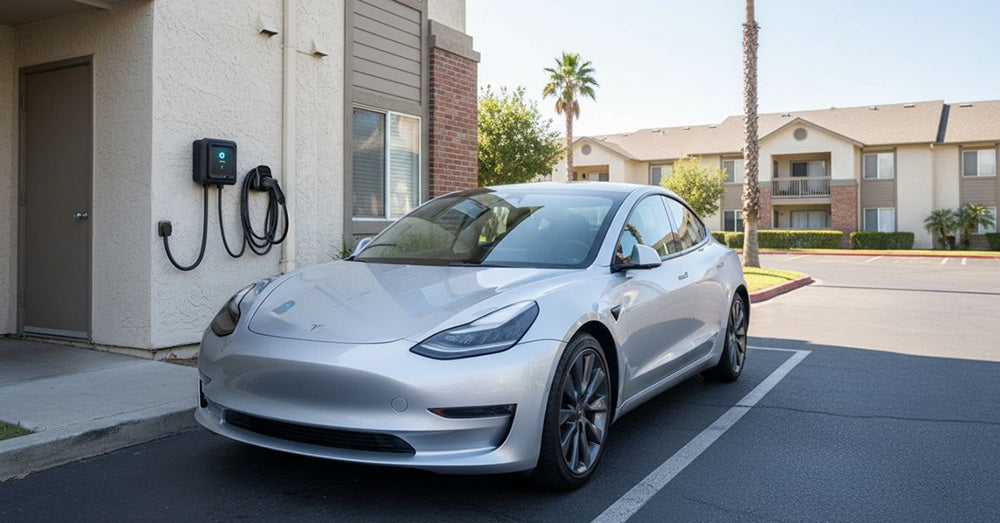
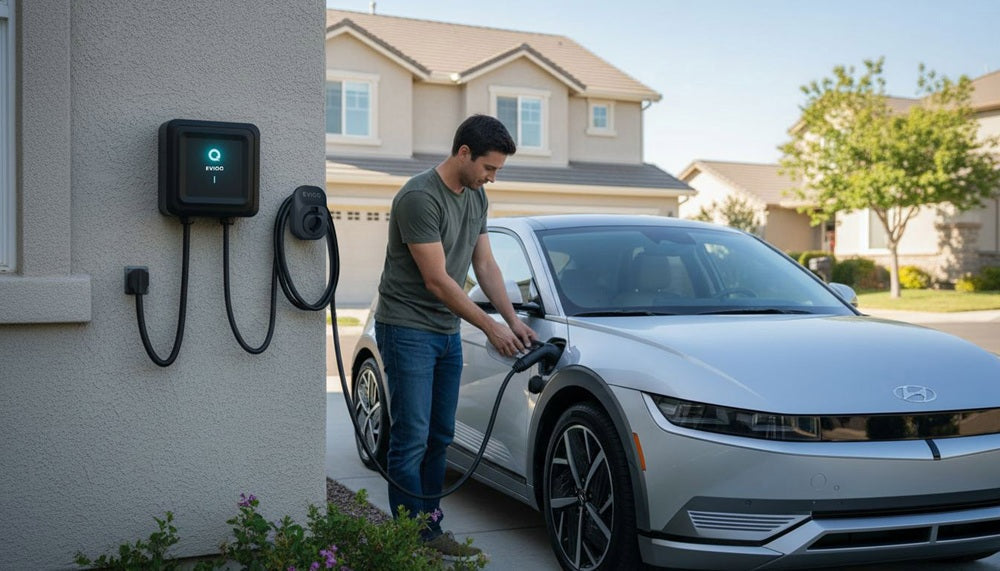


Leave a comment
This site is protected by hCaptcha and the hCaptcha Privacy Policy and Terms of Service apply.