
EV Charger Rebates & Tax Credits 2026
Get up to $1,000 federal tax credit (deadline June 30, 2026) + state and utility rebates on your home EV charger. Check your eligibility by ZIP code in 30 seconds.

See every EV charger rebate available in your area
We search federal, state, and utility programs from the U.S. Department of Energy database. Get personalized results in under a minute.
How to find your EV charger rebates
Save hundreds (sometimes thousands) on your home EV charger. Most rebates are free money — you just need to know where to look.

Enter your ZIP code
We instantly map your ZIP to your state, utility company, and local programs.

See your matching programs
We show you every federal, state, and utility rebate that applies to home EV chargers in your area, with direct links to apply.

Apply and save
Follow each program's application steps. Most rebates are processed within 4-8 weeks after charger installation.

The federal EV charger tax credit (Section 30C)
The Alternative Fuel Vehicle Refueling Property Credit (Section 30C) covers 30% of the cost of a qualified home EV charger and its installation — up to $1,000. Originally extended through 2032 by the Inflation Reduction Act, the credit deadline was accelerated to June 30, 2026 by the One Big Beautiful Bill Act (signed July 2025). Equipment must be placed in service by that date to qualify.
- 30% of cost — charger + installation labor
- Up to $1,000 maximum for residential property
- Available through 2032 via the Inflation Reduction Act
- Eligible ZIP areas — low-income and non-urban census tracts
EV charger rebates by state
Most U.S. states stack their own rebate programs on top of the federal credit. Here are some of the largest programs — check your ZIP for full local results.
Don't see your state? It probably has programs anyway — use our ZIP checker.
Utility rebates on home EV chargers
Your local electric utility may offer a rebate when you install a Level 2 charger — programs vary widely by region. Some pay cash back ($250–$2,500), others offer off-peak charging credits ($400/year), and a few cover panel/wiring upgrades. Use the ZIP checker for your exact options.


How to claim your EV charger tax credit
Install a qualifying Level 2 charger
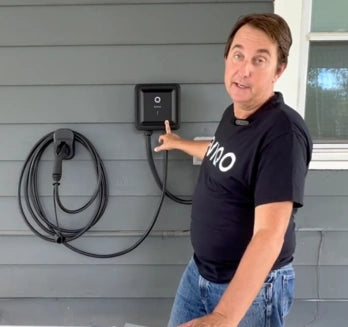
Section 30C requires a qualified EV charger installed at your primary or secondary U.S. residence. EVIQO chargers meet all eligibility requirements.
Keep all receipts and documentation
Save your charger receipt, electrician invoice, permit, and any utility rebate confirmation. You'll need these for both the federal credit and state programs.

File IRS Form 8911 with your tax return
Submit IRS Form 8911 (Alternative Fuel Vehicle Refueling Property Credit) when you file taxes. The credit reduces your federal tax liability dollar-for-dollar — up to $1,000.

Apply for state and utility rebates separately
Each state and utility has its own application process — usually a short online form. Most pay out within 4-8 weeks of charger installation.

EV charger rebate FAQ
How do I claim the EV charger tax credit?
To claim the federal EV charger tax credit (Section 30C), install a qualifying Level 2 home charger, keep your receipt and installation invoice, then file IRS Form 8911 with your tax return. The credit covers 30% of cost up to $1,000.
Is there a tax credit for installing an EV charger?
Yes. The Alternative Fuel Vehicle Refueling Property Credit (Section 30C) provides a federal tax credit of 30% of the cost of a qualified home EV charger and installation, capped at $1,000. Important: the One Big Beautiful Bill Act (signed July 2025) accelerated the deadline — equipment must now be placed in service by June 30, 2026 to qualify. After that date, the credit drops to $0.
Does my home EV charger qualify for the federal tax credit?
A qualifying charger must be installed at your primary or secondary U.S. residence, and your property must be in an eligible census tract (low-income or non-urban area). Use our ZIP checker above to confirm eligibility for your specific address.
Can I combine federal, state, and utility rebates?
Yes. The federal Section 30C credit, state-level rebates, and utility programs can typically be stacked. Most EVIQO customers combine these for $500-$1,600 in total savings on a home charging setup.
How long do rebates take to receive?
The federal tax credit reduces your tax bill when you file annually. State and utility rebates typically pay out within 4-8 weeks of charger installation, depending on the program.
Do EVIQO chargers qualify for rebates?
Yes. EVIQO Level 2 chargers meet all federal, state, and utility program requirements for residential EV charging equipment. They are UL-listed and Energy Star qualified.
Ready to find your savings?
Federal Section 30C credit ends June 30, 2026. Combined with state and utility rebates, most EVIQO customers save $500–$3,500. Check your eligibility now.
